Why it matters
- The Coastal GasLink pipeline runs through a corridor that is not incidental geography but a strategic artery of national consequence — the passage through which Canada’s LNG export ambitions must flow.
- The “pristine wilderness” narrative was manufactured through selective access and curated imagery — the world’s largest sawmill, a century of logging, and the strong community support for the project were all kept out of the frame.
- Two radicalisms converged at the drill site: a climate advocacy movement that had adopted a warrior frame, and an anarchist current with a revolutionary anti-capitalist program. The result was $14.5 billion in cost escalation, $20 million in sabotage damage, and lateral violence borne almost entirely by the communities the protest claimed to protect.
- The elders who filled a Houston movie theatre in February 2020 — two years before the attack — were already asking for an honest version of their story. Canada still owes them one.
“Allyship between Indigenous warriors and anarchists.”
— Molly Wickham, CGL protest leader, on the It’s Going Down podcast
The first time I drove the Morice River logging road, the snow was so deep that the fir branches on either side had closed overhead into a kind of tunnel, and the world outside my windshield had contracted to a cone of pale light. It was the kind of country that makes you understand, immediately and without argument, why people fight over it. The river itself, when I caught glimpses of it between the trees, was the colour of pewter under a January sky, running clear and fast over a gravel bed that the Wet’suwet’en have fished for salmon since before the idea of Canada existed. The Wedzin Kwa, they call it. The strong, clear water.
I had come here because the story emerging from this valley didn’t quite add up. I had spent years covering natural resource disputes in British Columbia. I had watched the choreography of a protest camp before. But something about the Coastal GasLink conflict felt different. More orchestrated. More deliberate. The cameras seemed to arrive before the protesters did.
What I found, after years of examining regulatory filings, court records, intelligence assessments, crowdfunding databases, academic papers, and the surprisingly candid public statements of the people involved, was not a spontaneous uprising. It was a manufactured one. And the drill site at the Morice River crossing had been chosen as its stage with considerable care.
The chosen ground
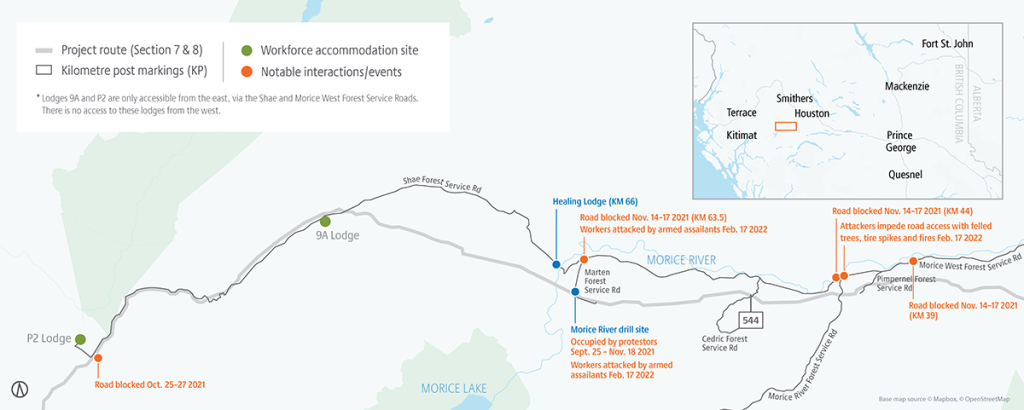
By the time I first drove that road, the Coastal GasLink project had cleared every legitimate hurdle that Canadian regulatory and legal institutions could place in front of it. It had obtained an Environmental Assessment Certificate from the Province of British Columbia. It had secured free, prior, and informed consent from all twenty First Nations along its 670-kilometre route through their elected band councils. It had survived multiple court challenges. The Wet’suwet’en hereditary leadership was itself divided, with clan matriarchs and a substantial majority of community members supporting the project or the economic benefits flowing from it. In Witset, the nearest First Nations community to the drill site, surveys suggested something close to eighty per cent support.
This is the project that, in the manufactured narrative, had to be stopped.
How do you manufacture a crisis around something approved through every mechanism a democratic society makes available? You choose your ground carefully. You identify the most remote, most symbolically resonant location on the entire route — a drill site crossing a headwater tributary, in deep winter, accessible only by logging road. You build a story around it. And then you surround that story with carefully styled actors and an intricately arrayed modern media amplification apparatus unlike anything previously seen in a Canadian resource dispute.
The drill site wasn’t the front line of a grassroots uprising. It was a stage. The cameras were already rolling when the escalation arrived. Journalists and documentary filmmakers embedded with protesters, not as neutral observers but as participants in the narrative. Images were curated, distributed through international networks, and framed with precision: “Indigenous land defenders” against “colonial infrastructure.” The overwhelming majority who supported the pipeline didn’t fit that frame. The matriarchs who endorsed it didn’t fit. The elected councils who had negotiated revenue-sharing agreements didn’t fit. So they were edited out — not through conspiracy, but through the ordinary mechanics of a media environment that rewards conflict over consent and drama over complexity.
What the cameras captured at the drill site wasn’t the story of the Coastal GasLink project. It was the story of dissent that had been assembled from anarchist networks, funded through international giving platforms, amplified through sympathetic academic ecosystems, and aimed with increasing precision at a project whose approval the protesters could not undo through any legitimate means. That’s why violence became the endpoint.

Introduction: The Manufacturing of Dissent: When Violence Came to the Pipeline
A new investigative series examines how the Coastal GasLink protests became a cautionary tale about who gets to decide Indigenous economic futures.
Part 1: The Attack
The February 2022 violence, the school bus, and the forensic evidence connecting peaceful protest infrastructure to coordinated assault.
Part 2: Whose Voices Were Silenced?
The matriarchs who were removed, the 80% who were ignored, and the eco-colonialism practiced in the name of allyship.
Part 3: The Protest Industrial Complex
Following the money ($1.9M crowdfunded, $40M from U.S. foundations), the professional protesters, and the media machine.
Part 4: The Corridor
How environmental protest became infiltrated by violent extremists—and who welcomed them.
Part 5: The Model Exported: What Comes Next
The PRGT pipeline, the playbook being redeployed, and the path toward real economic reconciliation.
Not Eden
Central to the protest movement’s media strategy — and central to how it landed in the minds of sympathizers in San Francisco, Cabbagetown, and Stuttgart — was a particular visual and narrative claim: that the Coastal GasLink pipeline was being driven through an unspoiled wilderness. A pristine, ancient landscape untouched by industrial modernity, inhabited by people living in right relationship with the land, about to be violated by a corporation that felt it had a right to go anywhere.
I understand why that story was compelling. The Morice River valley is genuinely spectacular. The river, the mountains behind it, the glaciers visible on clear days, the salmon moving through water the colour of old glass — these are things that stop your breath. I have been stopped by them. Anyone who drives that road with their eyes open will be.
But the protest movement’s photography, consistently and apparently deliberately, did not show what else was also true of that landscape: that it has been part of the industrial resource economy for well over a century. Houston, the nearest town, was established as a tie-cutting centre for the Grand Trunk Pacific Railway beginning around 1912. The forestry industry came next and never really left. By 1949, according to local records, between 67 and 84 sawmills were operating in the Houston district. A large integrated forest complex was built four miles west of town in 1969 by Bowater-Bathhurst and later operated by Northwood; it employed hundreds of people for decades. Forest tenures in the Morice River watershed have been active for generations, with logging roads pushing deep into the drainages long before any pipeline was proposed, and vast areas under various stages of harvesting and regeneration that are easily visible from the air and from the few roads that penetrate the interior.
The Huckleberry Mine, an open-pit copper and molybdenite operation, opened 123 kilometres southwest of Houston in 1997 and at its peak processed 20,000 tonnes of ore per day. Mining in the broader area dates to the 1860s, when prospectors following the Overland Telegraph Trail began working the creeks for gold. The region’s mining history stretches through silver, lead, zinc, coal, and copper operations across more than 150 years.
And then there was the sawmill. On February 9, 2004, Canfor opened what was at the time the largest sawmill on earth, just outside Houston. When Premier Gordon Campbell cut the ribbon, he enthused that the facility could produce enough lumber to build all of British Columbia’s new annual housing stock by itself — an estimated 600 million board feet per year, a quarter more than its closest global rival, which was in Germany. This was the industrial reality of the landscape the protest movement had chosen as its unspoiled Eden. Throughout the years when the Coastal GasLink conflict dominated international headlines, when the imagery of pristine river valley and ancient Indigenous territory was circulating through inboxes in San Francisco and Stuttgart, the world’s largest sawmill was running shifts a short drive down the road. Canfor closed the Houston mill in early 2023, and by May 2024 had abandoned plans for a replacement facility, citing declining timber supply and a regulatory environment that made a $200-million reinvestment impossible to justify. That closure is a genuine loss for Houston and for the families who depended on it. But its existence during the protest years — its sheer, un-photographed, un-narrated industrial scale — is its own kind of evidence about what was actually being left out of the frame.
None of this erases the beauty of the river valley. None of it diminishes the significance of the Wet’suwet’en’s relationship with the land or the ecological importance of the Morice as a salmon-bearing watershed. These things coexist. That is what a working landscape looks like, in northern BC and everywhere else people have lived and worked in proximity to nature for generations.
But the protest movement’s imagery didn’t show a working landscape. It showed only the mountain backdrop, the river, the snow, and the camps. The clearcuts, the regenerating second growth, the logging roads, the mine road, the industrial buildings at Houston — none of these appeared in the photography distributed through what one might call the protest industrial complex’s publishing apparatus. They didn’t fit the binary that needed to be projected into the minds of the movement’s international donor base: a garden of Eden threatened by desecrating modernity.
The binary worked. Donations flowed from people who had no idea what the landscape actually looked like, who were picturing something closer to old-growth cathedral forest than to the mosaic of second-growth timber stands, cutblocks, and resource roads that actually characterize much of the terrain. A supporter in Stuttgart or San Francisco donating to protect what they imagined was an ancient untouched wilderness was, in a sense, donating to protect a fiction. A beautiful fiction, but a fiction nonetheless.
This matters not because it undermines the ecological significance of the Morice — it doesn’t — but because it reveals something about the nature of the campaign. A movement that tells the full truth about a landscape it is trying to protect will show you the mine roads alongside the river. A movement engaged in manufacturing a narrative will show you only what serves the narrative. The protest movement showed you the river. It did not show you the clearcuts.
Who could get in
The selective visual narrative didn’t sustain itself by accident. It was sustained by geography, by logistics, and by the social dynamics of the protest camps themselves — all of which combined to function as a remarkably effective filter on who could get in, what they could see, and under what conditions they could move around.
The Morice River Forest Service Road is an industrial road. That designation carries practical implications that most people covering the conflict from city newsrooms, or processing the protest movement’s photography from offices in Toronto and Berlin, had no reason to think about. Industrial roads are built for logging trucks, not passenger vehicles. They are unlit, unpaved, often single-lane on blind curves, subject to washouts and winter conditions that can strand a vehicle far from any assistance. Driving them safely requires preparation: the right vehicle, the right tires, communications equipment, knowledge of radio etiquette for logging truck traffic, an understanding of what to do if something goes wrong in a place where cell service does not exist and the nearest town is an hour away in good conditions.
For journalists embedded with the protest camps, none of this was an obstacle. The camps provided transportation, local knowledge, guides, and the social infrastructure of a community that had been living on that road for years. A sympathetic documentary filmmaker from Vancouver or a correspondent for a European environmental publication could be welcomed into the camp, oriented, and taken to exactly the locations that told the story the camp’s communications team wanted told. The clearcuts would not be on that itinerary. The mine road would not be on it. The residents of Witset who supported the project in large numbers and lived an hour’s drive down Highway 16 would not be on it.
For journalists who were not embedded — who arrived independently, without prior relationships with the protest leadership, or who were known to be from outlets the movement regarded as unsympathetic — the experience was different. The physical preparation alone was a significant commitment. And the camps themselves were not welcoming to outsiders who hadn’t been pre-cleared.
I know this from experience. On one occasion, investigating a railroad blockade set up in solidarity with the Morice River protests, I walked onto the blocked track to try to understand what was happening and to speak with the people responsible. An angry man approached me and made it clear, in terms that left little room for interpretation, that my presence was not welcome. All of this unfolded under the watchful eye of a so-called peace observer — an American, embedded with the protest, there to monitor and document any violations of the demonstrators’ rights. He watched me warily throughout. Whether the threat I received was genuine or performative, the effect was the same: I retreated. I have reflected on the peace observer’s presence many times since. Here was someone who had travelled from the United States, in an official capacity of neutral witness, to stand guard over a blockade of a Canadian railway in the middle of a dispute whose full complexity he almost certainly had not come prepared to find. That, I thought, was one of the richest ironies of the entire episode — the peace observer, embedded with one side, watching the other side’s representative warily, on a blocked track in the BC interior, while a man threatened me a few metres away. It was a compact illustration of what “neutral” had come to mean in this conflict. It was a reminder, too, that controlling physical access to a protest site is also a form of narrative control. You can’t photograph what you can’t get near. You can’t interview people who won’t speak to you. And if the experience of attempting access is threatening enough, a reasonable journalist will conclude that the risk isn’t worth it and will work instead with the material that is made easily available — which is to say, with the protest movement’s own photography and framing.
The result was a sustained information asymmetry. For years, the imagery and the narrative coming out of the Morice River corridor were almost entirely produced by or filtered through people sympathetic to the protest movement. Handpicked outlets from the eco-left press had a free hand. They could go where they wanted, photograph what they chose, and tell the story in the frame that the camps had prepared for them. The gallery of images that circulated internationally — the river, the mountains, the camps at dawn, the RCMP in tactical gear, the Women’s Warrior Flag — was a curated exhibition, not a documentary record.
It was only late in the escalation, as the conflict rose to a crescendo and the February 2022 attack made it impossible for mainstream news organizations to continue relying on embedded sources alone, that outside correspondents began making the trip in significant numbers. And something interesting happened when they did. The narrative began to collapse under the weight of actual reporting. Journalists who arrived without prior commitments to the protest movement’s framing started finding things that didn’t fit: the strength of community support, the benefit agreements, the matriarchs who backed the project, the lateral violence within the community, the international anarchist networks that had made themselves at home in the camps. The story was considerably more complicated than years of curated imagery had suggested.
By then, of course, the dominant frame had been established. The images had circulated. The donations had been raised. The international solidarity network had been activated. A narrative, once it achieves sufficient circulation, develops a momentum that subsequent reporting struggles to reverse. The correction, when it comes, rarely travels as far as the original story.
The wrong symbol
The Morice River does not cross the Coastal GasLink pipeline route by accident or by arrogance. It crosses it because physics and geography made it unavoidable. The 670-kilometre pipeline runs from the gas fields of northeastern British Columbia to the LNG Canada terminal at Kitimat, and the Morice — a glacier-fed salmon river of exceptional ecological significance, known to the Wet’suwet’en as the Wedzin Kwa — sits squarely across that corridor. A crossing was always going to happen.
What was not predetermined was how that crossing would happen, or exactly where. After the original Environmental Assessment Certificate was issued in 2014, CGL launched an ongoing consultation programme with Wet’suwet’en communities. What emerged from that engagement — not from regulators, not from engineers — was a specific environmental concern: that construction activities south of the Morice River could damage the underground springs that feed the river. The company listened. Over two years, CGL commissioned environmental, archaeological, and engineering field studies to evaluate an alternate corridor. In November 2017, it filed an amendment application with the BC Environmental Assessment Office. In May 2018, that amendment was approved. The South of Houston Alternate Route moved the pipeline approximately 3.5 kilometres north, directly addressing the hydrology concern that community members had raised.
Amending an EA certificate after issuance is not trivial. It requires new studies, new regulatory review, new public engagement. CGL initiated that process, funded it, and saw it through without being ordered to. The springs concern came from the community. The response came from the company.
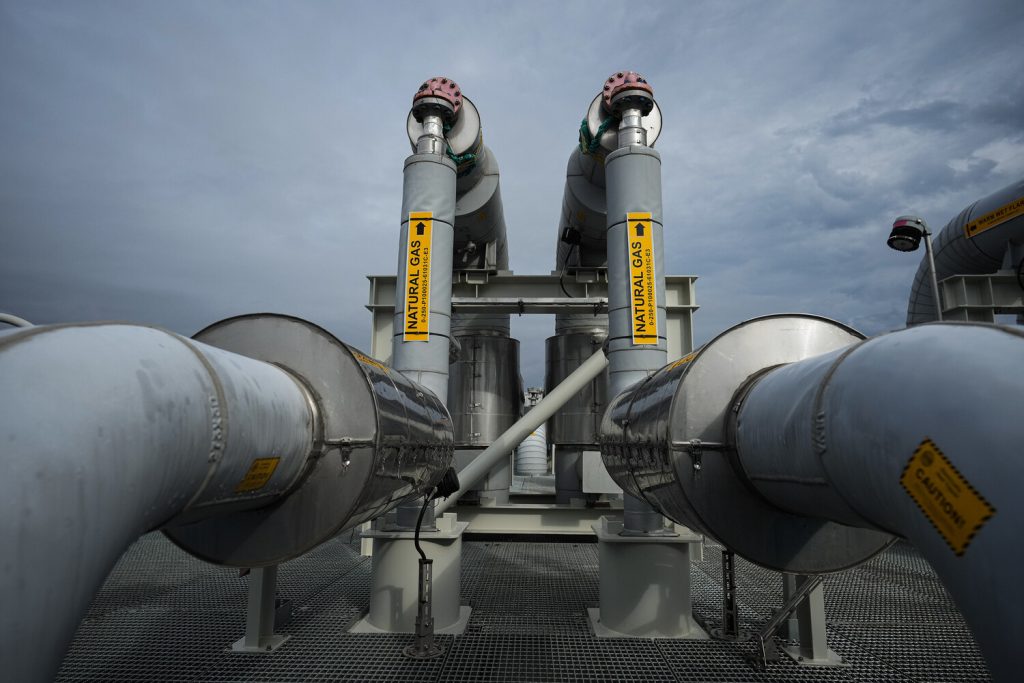
Then came the question of the crossing method itself. The standard industry approach would have been horizontal directional drilling — HDD. But the subsurface geology around the Morice, the very hydrologically complex terrain that had generated the springs concern, created unacceptable risk of a frac-out: a pressure-induced fracture that could push drilling fluid up through the riverbed and into the water column. CGL’s engineers determined that micro-tunneling was the appropriate method — hydraulic jacks advancing a tunnel boring machine through the earth, installing sealed concrete segments as it progresses. The result is a structurally supported concrete tunnel more than 800 metres long, running 11 metres below the riverbed, with the pipeline pulled through only after the tunnel casing is complete and tested.
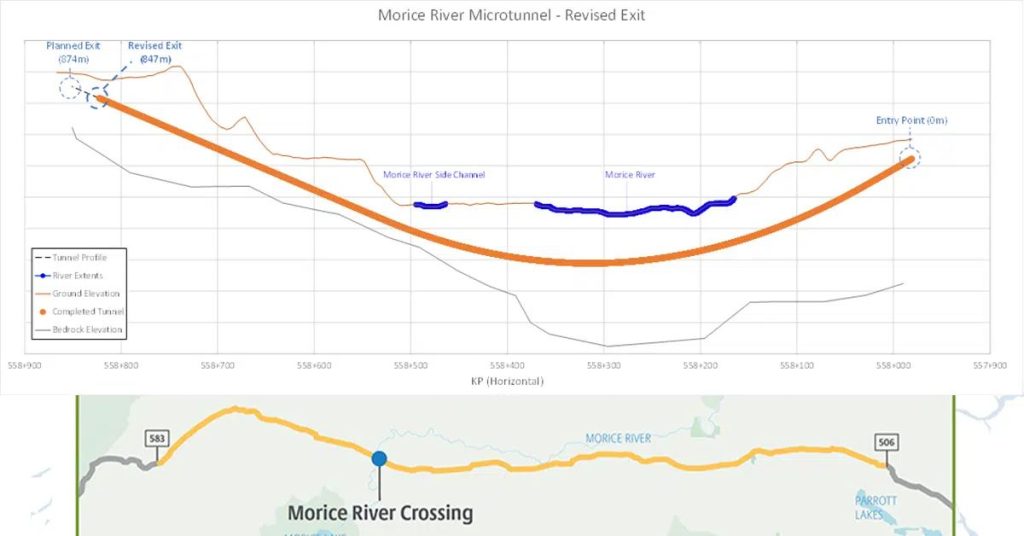
This decision cost money — significant money. CGL had estimated the tunneling phase at approximately three months. It took nine. Two minor releases of bentonite clay lubricant occurred during drilling in April 2023 — events that CGL self-reported to regulators the day they were detected, investigated by the BC Energy Regulator, and remediated under the supervision of aquatic environmental specialists, with Indigenous community monitors from the Construction Monitoring and Community Liaison Program on site throughout.
Here is the point that needs to be made plainly. If you were designing a symbol of reckless resource extraction — a location that embodied corporate contempt for Indigenous knowledge and ecological values — the Morice River drill site is quite possibly the worst symbol you could have chosen. A company heard environmental concerns from Indigenous people. It changed its route, voluntarily, at its own expense. Then it selected the most protective crossing technology available, at enormous additional cost, precisely because the ground conditions demanded it. Indigenous community monitors were present throughout. Incidents were self-reported immediately. The crossing was completed.
The drill site at the Wedzin Kwa represented resource development as it is supposed to work. And yet. The drill site was where the axes came out.
The price tag of opposition
One way to understand the scale of what happened along the route is to follow the money — specifically, the money that wasn’t supposed to be spent.
When TC Energy announced the Coastal GasLink project, the budget was $6.6 billion. In July 2022, the company disclosed a first major revision: costs had risen to $11.2 billion, a seventy per cent increase from the original estimate. The company cited challenging conditions in the Western Canadian labour market, shortages of skilled tradespeople, and contractor underperformance and disputes. Six months later, in February 2023, TC Energy’s CEO François Poirier disclosed that a comprehensive cost and schedule risk assessment had produced a new figure: $14.5 billion. That represented a thirty per cent increase from the already-revised July estimate, and a project cost more than double what had originally been sanctioned.
On the analyst call following that February disclosure, the reaction was blunt. RBC Capital Markets analyst Robert Kwan wrote that “given the history of cost overruns, we believe the cost and timing of the project will be an overhang for the stock.” Analysts from BMO, Scotiabank, Goldman Sachs, and TD Securities pressed management hard. Of ten analysts asking questions that morning, six focused on Coastal GasLink. TC Energy’s Toronto-listed shares fell 6.5 per cent on the day, having already lost eighteen per cent since November. The company also disclosed a $2.6-billion writedown of its equity investment in Coastal GasLink LP.
TC Energy was careful in its public language, citing labour conditions, contractor underperformance, drought, and erosion control challenges — the ordinary vocabulary of infrastructure overruns in difficult terrain. The company explicitly declined to attribute cost increases to protest activity. The protest movement, just as predictably, claimed credit for every dollar. Wet’suwet’en hereditary chiefs opposing the project told media that the escalation showed their resistance was working. Stand.earth’s climate finance director told the National Observer that TC Energy would never admit it, because it would be an admission the strategy was effective.
The truth is more complicated than either narrative. The Morice crossing alone — nine months of tunneling instead of three, specialized equipment brought in at premium rates — was a genuine and significant contributor to cost. So were the other 800 water crossings along the 670-kilometre route, the labour market conditions during a pandemic-era construction boom, and contractor disputes common on megaprojects of this scale. Disentangling the specific cost of protest-related delay from the other factors is not something the public record allows.
What the record does allow is this: $14.5 billion, more than double the original estimate, was real money with real consequences. TC Energy was forced to sell more than $5 billion in assets to fund completion and reduce leverage. The pipeline was built. The gas flows. But the financial story of Coastal GasLink is a record of what organized opposition, whatever its moral valence, can do to the arithmetic of major infrastructure.
Two radicalisms, one fire
To understand how a project this thoroughly vetted became the site of a coordinated violent attack, you have to understand something about the strange alchemy that occurs when two different strains of fringe radicalism find each other and discover a shared enemy.
The opposition to Coastal GasLink did not begin with anarchists. It began in the conventional precincts of the environmental movement: climate advocacy, pipeline opposition, concerns about LNG expansion, and the legal argument that Wet’suwet’en hereditary governance authority superseded the consent given by elected band councils. These were recognizable positions, the kind that appear in legal briefs and academic journals and fundraising letters from established ENGOs. The people who held them, for the most part, did not romanticize violence. They wanted injunctions and media coverage and government negotiations.
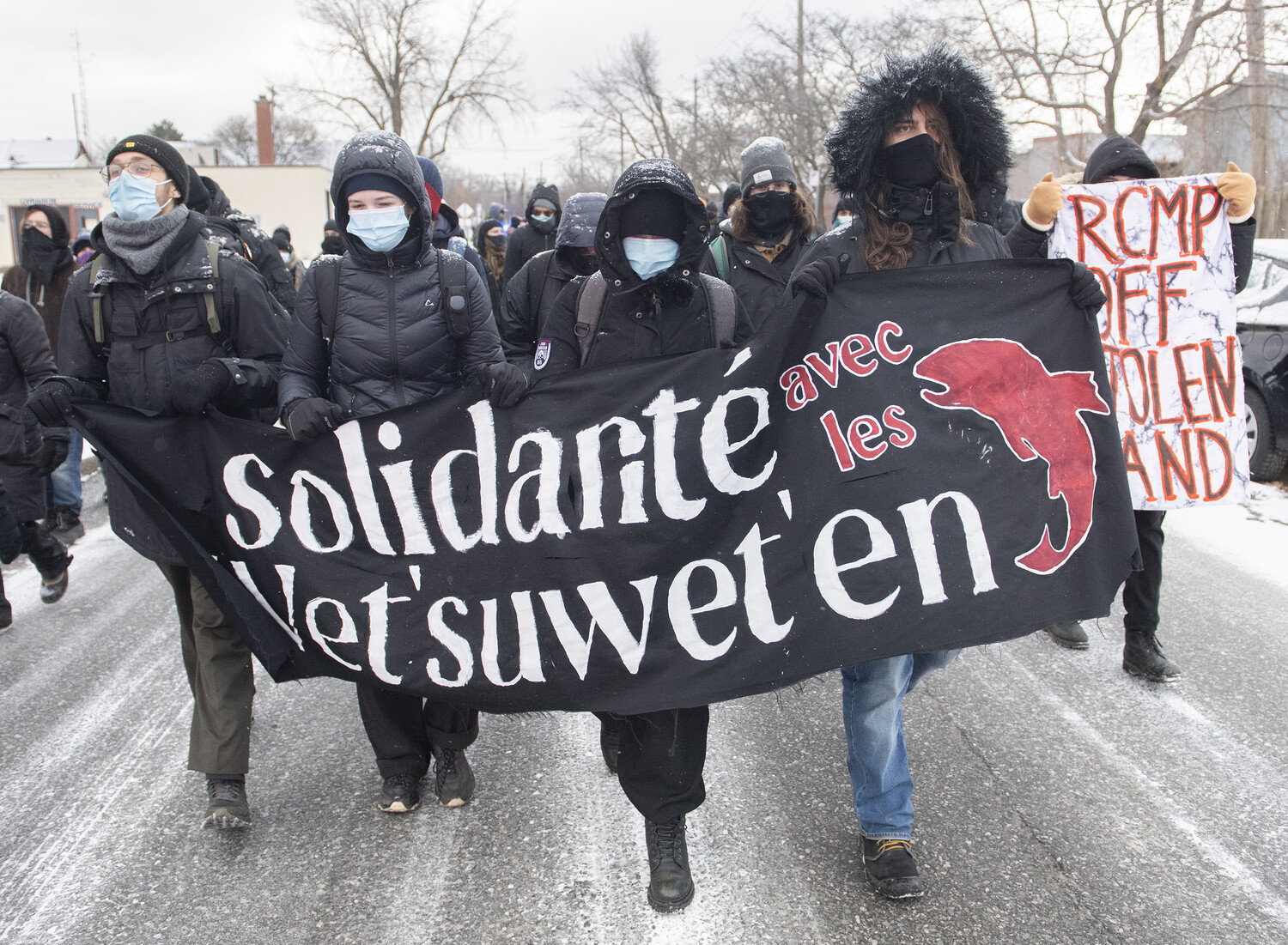
But somewhere in the years-long campaign against CGL, a second current entered the stream. It arrived carrying a different vocabulary — “warriors,” “decolonization,” “land defence” — and a different understanding of what legitimate resistance looked like. The warrior framing does specific ideological work. Warriors don’t negotiate. Warriors don’t sign benefit agreements. Warriors don’t recognize the authority of courts or the Environmental Assessment Office or elected band councils. Warriors hold the line by any means necessary.
When that warrior framing collided with the anarchist current — which brought its own vocabulary of sabotage, direct action, and the illegitimacy of industrial civilization itself — the resulting compound was something different from either of its components. The climate advocates who had launched this campaign a decade earlier would not have recognized what it became at the drill site in February 2022. Many of them were genuinely disturbed by what they saw. But they had helped build the infrastructure, the narrative, and the moral permission structure that the more radical elements moved into and occupied.
In that convergence, all bets were off. The climate advocates had wanted headlines. The anarchists wanted wreckage. The warrior frame had provided a moral architecture in which wreckage could be presented as something other than what it was. When those three elements fully combined, at a remote drill site in the middle of a northern BC winter, the result was as predictable as it was indefensible.
The climate advocates had wanted headlines. The anarchists wanted wreckage. The warrior frame had provided a moral architecture in which wreckage could be presented as something other than what it was.
The open invitation
Someone had to choose that drill site as the symbol. Someone had to frame it, film it, and distribute the story of what was happening there to audiences in Toronto and London and New York who would never in their lives drive a northern BC logging road. Someone had to recruit the bodies willing to stand in front of equipment in January — and, eventually, to swing axes at it in the dark.
That required a network. And building that network required an open invitation.
Molly Wickham — known by her Wet’suwet’en name Sleydo’, a prominent protest leader and the movement’s most visible spokesperson — appeared on a platform called It’s Going Down. For readers unfamiliar with it: It’s Going Down is a podcast and web publication dedicated to anarchist news and analysis. It doesn’t present itself as anything other than what it is. Wickham appeared there voluntarily, and she spoke openly about what she described as “allyship between Indigenous warriors and anarchists.”
Appearing on an anarchist platform to discuss the strategic value of anarchist allyship is not coalition-building in the ordinary sense. It is a deliberate articulation of ideology. It is saying, in public, on the record: we see you, we want you here, your participation in this conflict is welcome.
The consequences of that welcome were not difficult to foresee, if you were paying attention. Anton Bueckert, a self-described eco-anarchist arrested at a CGL protest site, later explained the underlying logic: anarchists support “the indigenous factions whose politics are resonant with theirs.” Not Indigenous sovereignty as a universal principle. The specific factions. The ones who use the warrior frame. The ones who have already decided that legitimate processes are a form of colonial imposition.
It’s transactional, not principled. The strong majority of Wet’suwet’en community members who supported CGL were also exercising sovereignty. The elected band councils that negotiated agreements, the clan matriarchs who gave consent, the community members in Witset who chose economic partnership — they were all exercising sovereignty. Anarchists weren’t interested in supporting their sovereignty. Only the sovereignty that opposed pipelines.
The architect of connections
Some of the groups that made themselves at home in the CGL protest camps were not merely radical. They were under federal law enforcement scrutiny.
Deep Green Resistance is a movement built around the premise that industrial civilization must be dismantled and that sabotage is a legitimate tool for achieving that goal. The FBI has investigated it. DGR’s own published materials are explicit about what they call “decisive ecological warfare,” which includes attacks on infrastructure. Their involvement with the CGL protests was not limited to expressions of solidarity from a safe distance. They raised funds for the camps, promoted them through their networks, and had members present at the sites.
The individual who served as a key connector between DGR’s world and the CGL camps was Macdonald Stainsby, a BC-based professional protester who had been a fixture on the anti-oilsands circuit for decades before CGL became the central conflict. His biography is worth examining in some detail, because it illuminates something important about what kind of politics actually animated the radical fringe that attached itself to the Wet’suwet’en cause.
Stainsby attended the Unist’ot’en Camp and was described — in anarchist publications, not by his critics — as central to connecting CGL protesters with what he called “trouble-makers.” He wrote about his involvement at length in a piece published on It’s Going Down titled “Water, Land and Freedom: My Journey Through a Decade of Pipeline Resistance.”
Researcher Greg Renouf, who spent years documenting the professional protest networks operating in Canada through his publication GenuineWitty, has traced Stainsby’s ideological history in detail. What emerges is a portrait of someone for whom pipeline resistance was never primarily about environmental protection in any conventional sense, but about something considerably more radical: the revolutionary overthrow of capitalist industrial civilization itself.
In 2012, Stainsby publicly declared that voting was “problematic” because electoral politics was beside the point. He stated that humanity had “but one option, which is to either die in ecological collapse in the next couple of years or hope that climate catastrophes, continued economic collapses and the reality of peak oil force people into making the requisite changes needed — revolution.” This was not a fringe view he expressed once in passing. It was the consistent framework through which he understood and articulated his activism.
In early 2005, Stainsby wrote about how radicals needed to maintain a “united front” to save the world from imperialism, citing as inspirations “Chavez, Marx, Guevara or Simon Bolivar himself.”
The reference to Chavez was not incidental. In February 2015, Stainsby was among the participants at a pro-Venezuela rally held behind the Vancouver Art Gallery, organized by what called itself the Hugo Chavez People’s Defense Front. There, according to Renouf’s contemporaneous account, Stainsby praised the Venezuelan government, declaring that “the Revolution got an overwhelming victory that shows what the will of the people is.” His remarks were subsequently republished, in Spanish, on the website of the Venezuelan consulate in Arauca, Colombia — Canadian anti-pipeline activist as Bolivarian propaganda.
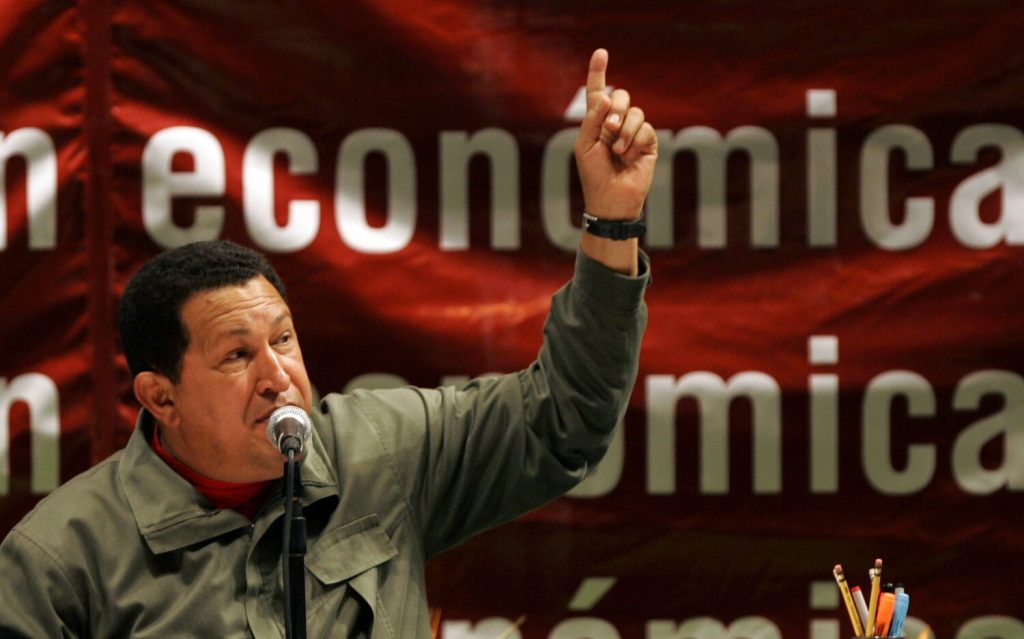
A year earlier, when Chavez died, Stainsby had written an extended tribute to the Venezuelan leader that ended: “Commander, thank you for so much beyond the borders of your magnificent country. The dignity you have instilled in the people cannot be destroyed. Only capitalist plots can be destroyed. You warned the people well of imperial plots. They are peaceful, but not unarmed. You will see it. We will fight because to struggle is life.” Shortly afterward, apparently feeling that this had not fully expressed his feelings, he publicly declared his love for the recently deceased Commander.
I am not raising Stainsby’s politics about Venezuela to suggest that the Wet’suwet’en opposition to CGL was secretly a Chavista operation. The connection is more structural than that. What it reveals is the nature of the ideological ecosystem from which the most radical elements of the CGL protest movement drew their key connectors and organizers. The people who built the bridges between the anti-pipeline camps and the violent extremist fringe were not, on examination, motivated primarily by concern for salmon or for Wet’suwet’en culture. They were motivated by a revolutionary anti-capitalist politics for which the pipeline — any pipeline — was a convenient and resonant target.
The curious irony, which Renouf noted with some justification, is that Stainsby was a passionate opponent of Canadian fossil fuel development while simultaneously cheering on the Venezuelan petrostate — a country whose entire economic foundation and revolutionary social project rested on oil extraction. The cognitive dissonance involved is considerable. But it illuminates something important about what “environmental” meant in this context. It didn’t mean less fossil fuel. It meant less capitalism. Different thing.
The tactics that travel
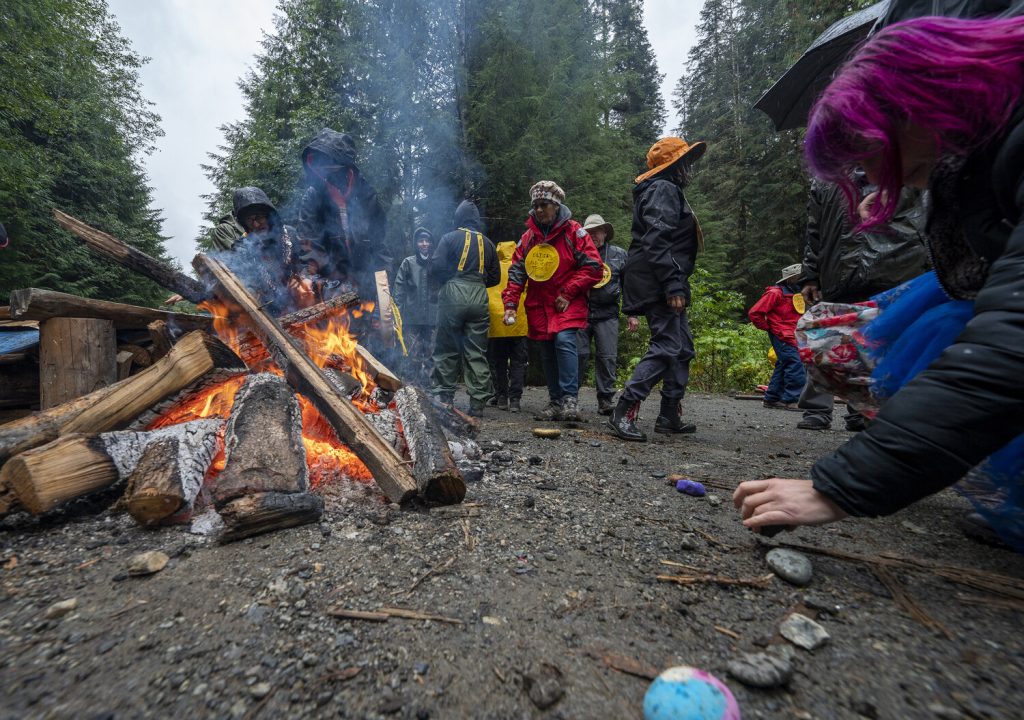
One of the things that struck me early in my research was how consistent the tactical repertoire was across different protest sites in British Columbia. The same methods appeared at Fairy Creek, at the Trans Mountain pipeline opposition, and at CGL — not because organizers independently invented the same solutions, but because many of the same people were present at multiple sites, and because formal training in protest tactics is a real thing provided by real organizations.
Tree platforms and road blockades perfected at Fairy Creek were deployed at CGL. Driveshaft lock-downs appeared at both locations, used by some of the same individuals. Cantilever logs, hedgehog configurations of vehicles surrounded by log spikes, elevated wooden towers requiring specialized equipment and significant time to dismantle: these are not improvised by amateurs. They reflect training, materials, coordination, and accumulated experience. Groups like the Ruckus Society have provided formal training in protest tactics for decades. Crowdfunding platforms provided materials budgets. Networks spanning multiple protest sites provided experienced personnel.
Each tactic was designed to be harder to remove than the last — more delay, more cost, more confrontation, a higher floor of normalized resistance. This is how radicalization works in movements, not just in individuals. The moral baseline shifts incrementally. The path from tree platforms to axes and flare guns is not linear. But it is not accidental either.
February 2022
I described the attack in detail in Part One. Here I want to revisit it through a specific lens: what the evidence tells us about planning, preparation, and the infrastructure of the movement that surrounded it.
The school bus used to block the access road had been part of the protest camp’s infrastructure for months, associated with Adam Gagnon and the Parrot Lake Group. The white camouflage worn by the attackers had appeared in earlier protest photographs — including images in which people holding axes posed beneath the Women’s Warrior Flag. The tactical sophistication of the attack — multiple simultaneous fires, blocked escape routes, coordinated movements in darkness — was not the signature of an impulsive act. The RCMP described it as “very aggressive and calculated.”
Twenty million dollars in damage. A CSIS assessment that the rail blockades organized in solidarity with CGL protests involved “ideologically motivated violent extremists.” That designation is applied when an agency has determined that violence is being deployed in service of an ideological programme. The ideology in question was not Wet’suwet’en land defence. It was radical environmentalism and anarchism — movements that had been explicitly welcomed into the CGL protests and that had their own agendas, their own networks, and their own understanding of how far was far enough.
The community hall, February 2020
I want to tell you about a room I stood in on February 20, 2020, almost exactly two years before the attack at the drill site.
It was Houston’s movie theatre — the town’s main public gathering space — and by mid-morning it was full. One after another, elders walked to the microphone and spoke.
I have recordings from that day. I am not going to quote from them, and I am not going to identify the people who spoke. What I heard in that room was private in a way that a journalist’s notebook cannot fully honour, and I have no wish to make public property of anyone’s pain. But I can tell you what I witnessed, and I think I have an obligation to tell it, because it was one of the most instructive days of my reporting life.
These were elders from communities that had known colonialism from the inside. They were not cheerleaders for capitalism. They had lived through the Indian Act, through residential schools, through the particular indignity of being told by the state what their culture was and wasn’t allowed to be. They carried that history in their bodies and in their voices, and anyone in that room who arrived expecting simple pro-development boosterism left disabused of the idea.
They had also lost daughters.
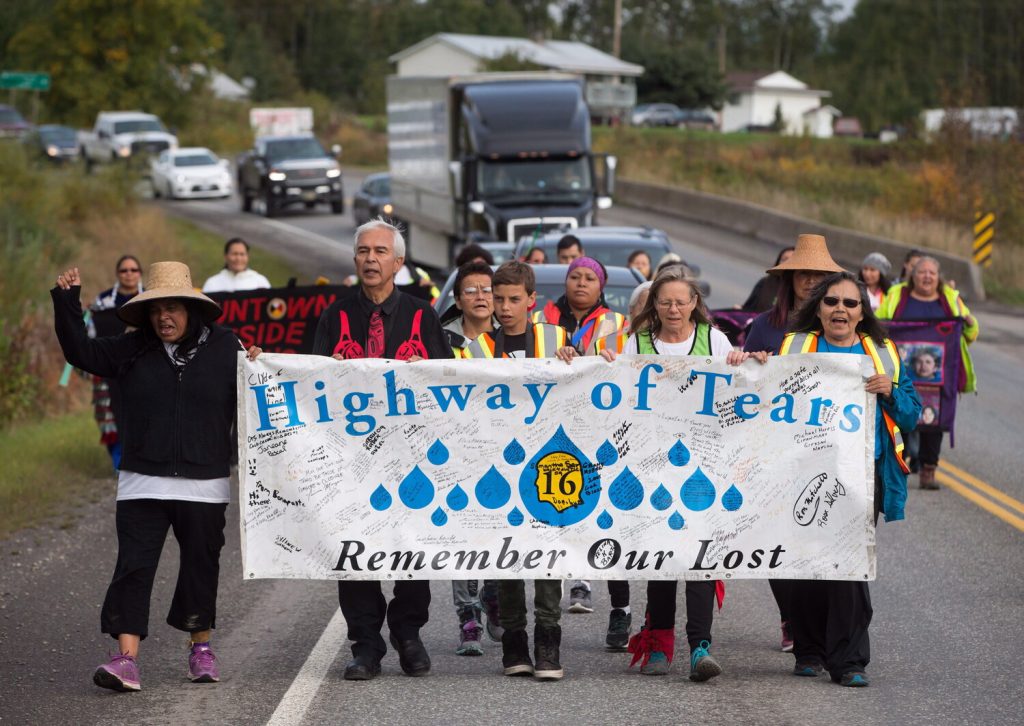
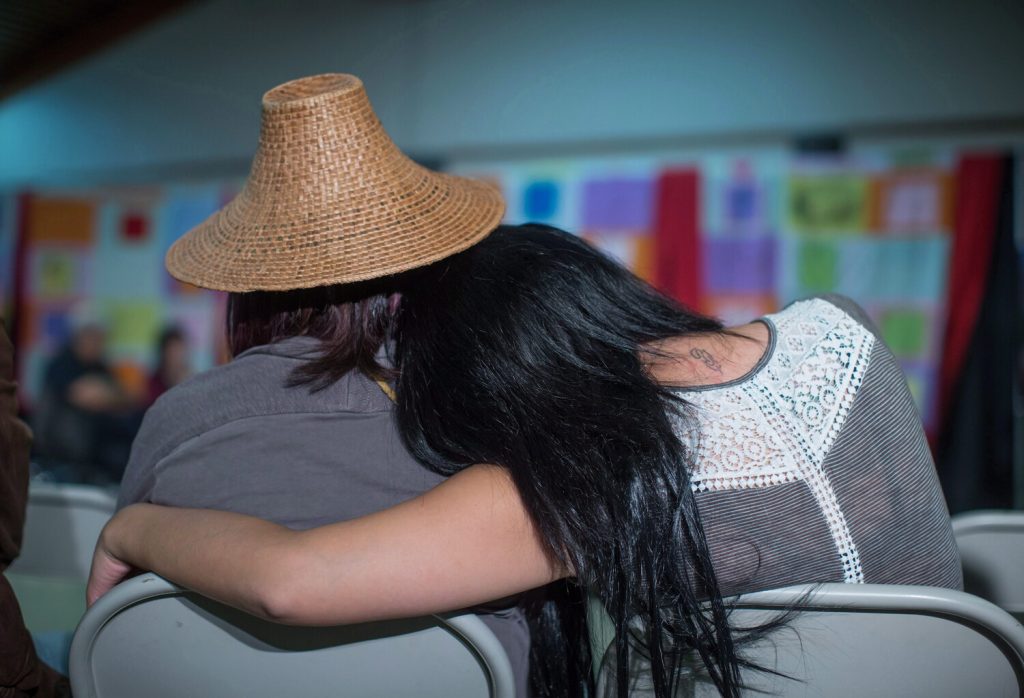
The Highway of Tears runs through this part of British Columbia — Highway 16, the same road I drove to reach the Morice River, the same corridor that connects Houston to Witset to Smithers to Prince Rupert. For decades, Indigenous women and girls disappeared along its length, hitchhiking between communities that had no other reliable transportation, and many were never found. When I visited communities along that highway in those years, it was not uncommon to see red dresses hanging from trees — the symbol of missing and murdered Indigenous women, a heartbreaking shorthand for a grief that ran deeper than any pipeline argument could reach. Those dresses were part of the landscape. They were part of what these communities were, and what they had endured.
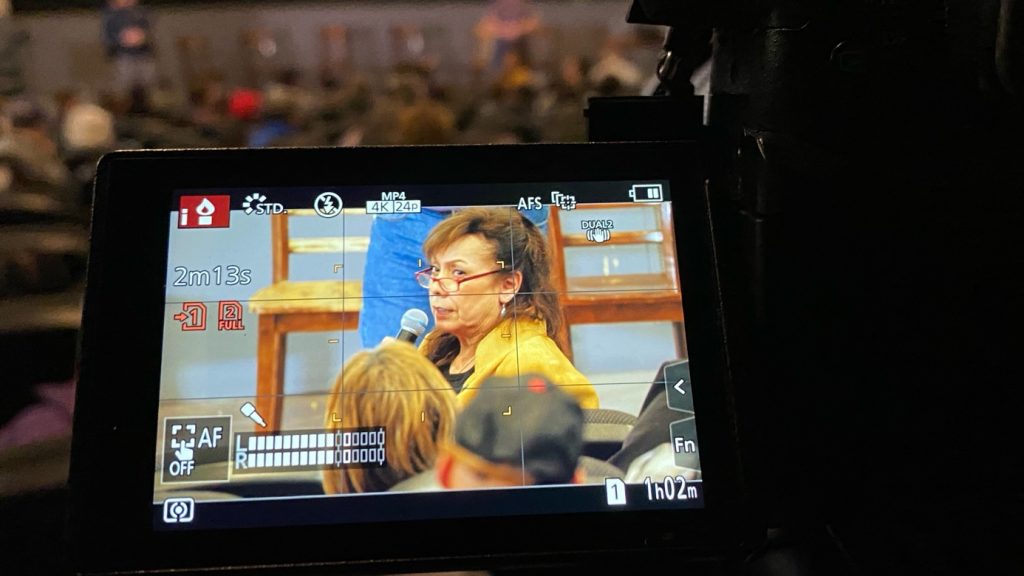
And yet. The elders who walked to the microphone that day in Houston were speaking in support of completing the pipeline. Not because they had forgotten the history, or forgiven it, or decided that the companies and governments that had wronged them were now to be trusted unconditionally. But because they had looked at what the benefit agreements had already produced — language programs, services for elders, safe bus services along a highway that had taken too many of their daughters, infrastructure that their band councils had been able to negotiate and fund because a company had come to the table willing to deal — and they had made a judgment that this was real, that it was theirs, and that they were terrified of losing it.
I have gone back to those recordings. The pain in those voices, the prospect of losing what had been so carefully and improbably built — it was almost more than those communities could carry. These were not people who had been handed anything. They were people who had learned, through long and bitter experience, not to expect anything from the state or from industry, and who had found, in the specific arrangements that CGL’s benefit agreements made possible, something they had not expected to find: a negotiated stake in their own economic future. The thought of outside agitators — many of them non-Indigenous, many of them from other parts of the country or the continent — arriving to tell them that this was the wrong kind of sovereignty, that their agreements were a form of collaboration with colonialism, that the correct answer was to refuse — the anger and the sorrow in those voices was not abstract. It was the sound of people who had already paid more than enough for other people’s principles.
I think about that room often when I read accounts of the Coastal GasLink conflict that centre the protest movement’s framing without remainder. The elders who spoke that night were not represented in that framing. They were the ones surveys had found in such numbers — rendered invisible by a narrative apparatus that had no use for them. Their grief, their pragmatism, their hard-won and carefully protected economic agreements — none of it fit the garden of Eden that needed to be defended. So it was left out, as the clearcuts were left out, as the world’s largest sawmill was left out, as the industrial roads and the mine sites and the logging history were left out.
The seeds of the distress that would culminate at the drill site two years later were already flourishing in that room. Not the distress of the protesters, but the distress of the people the protesters claimed to speak for. I heard it. I still hear it.
The price of opposition in human terms
The financial costs of the conflict are measurable. The human costs are harder to quantify, but they were borne almost entirely by the people the protest movement claimed to be protecting.
I had not encountered the term “lateral violence” before the CGL conflict brought it to my attention. It describes something that social scientists and Indigenous community health workers know well: the phenomenon of members of a marginalized community directing harm at one another rather than at the external forces that constrain them. Bullying, coercion, intimidation, ostracism, verbal abuse, and sometimes physical violence — inflicted not by outsiders but by community members on each other. It is a recognized pattern in communities under sustained pressure, and it is corrosive in ways that are difficult to repair.
At the Standing Committee on Indigenous and Northern Affairs in Ottawa, Theresa Tait-Day — Wi’hali’yte, a Wet’suwet’en hereditary sub-chief and president of the Wet’suwet’en Matrilineal Coalition, a supporter of the CGL agreements — put it directly to assembled MPs. “We have experienced lateral violence and coercion,” she told the committee, describing what had happened to women and elected leaders in her community since the conflict escalated. She spoke of patriarchal domination within the hereditary governance structure, of voices being silenced.
“These chiefs’ voices have been amplified by the skills and resources of outside environmental activists,” she continued, “who say that they support the Wet’suwet’en but whose primary interest is stopping the pipeline. The protest organizers are conveniently hiding beneath our blanket as Indigenous people, while forcing their policy goals at our expense. This compromises our Nation’s social well-being and our people’s economic futures.”
In Witset and surrounding communities, people who supported the pipeline — surveys suggested that was most people — became afraid to say so publicly. In a Resource Works investigation, a community member described an environment of fear: “bully tactics, lateral violence that doesn’t need to happen.” Workers who held CGL jobs, members of families that had signed benefit agreements, people who believed economic development was in their community’s interest — they watched their neighbours become proxies in a battle being fought primarily by and for people who would never live with the consequences.
The protest movement generated a great deal of attention to the suffering it attributed to the pipeline and the state’s enforcement of injunctions. What received almost no attention was the suffering inflicted within the community by the conflict itself. That story didn’t fit the frame. So it was left out.
The distancing
In the aftermath of the February 2022 attack, protest leaders did something entirely predictable: they distanced themselves from the violence.
Wet’suwet’en Hereditary Chief John Ridsdale, known as Na’Moks, told CBC: “We would never ever tell anybody or support anybody to do any kind of damage. We said we’re going to do this peacefully and we have done it peacefully.”
I believe he believed that. And the sincerity of that belief is part of what makes the story so instructive. Because the record that preceded the attack — the appearances on anarchist podcasts, the welcome extended to groups under FBI investigation, the infrastructure shared with attackers, the progressive normalization of escalating tactics — is also part of the record. Both things are true simultaneously. Protest leaders did not plan the attack. And the movement they led, and the choices they made about who to invite into it, created the conditions in which the attack became possible.
When you cultivate allyship with movements that advocate infrastructure sabotage, when you appear on their platforms and lend them legitimacy, when you accept their participation and benefit from their numbers, you do not get to fully control what they do next. You can disavow violence after the fact. But you cannot un-invite the people you invited.
The local response to the attack told its own story. According to CBC’s reporting, “a lot of our local community members were participating in some of the training they had… they got scared.” Protesters left. Numbers dropped sharply. The violence didn’t just damage equipment worth twenty million dollars. It damaged relationships, alienated supporters, and confirmed the fears of a majority of Wet’suwet’en people who had been watching the escalation with growing unease. They had not signed up for this. They said so, quietly, and then they went home.
Whose sovereignty
There is a phrase the protest movement used so consistently, and that sympathetic media amplified so reliably, that it became almost impossible to interrogate: “Indigenous sovereignty.” The Coastal GasLink pipeline was framed as a violation of it. The protest was framed as its defence.
Bueckert stated, with admirable honesty, that anarchists support “the indigenous factions whose politics are resonant with theirs.” Not Indigenous sovereignty as a principle. The specific factions. But the elected Wet’suwet’en band councils that negotiated and signed revenue-sharing agreements were also exercising sovereignty. The clan matriarchs who gave consent were exercising traditional governance authority. The community members in Witset who supported the project were exercising the sovereign right to make economic choices for themselves. All of those acts of sovereignty were invisible in the protest movement’s framing, because they led to the wrong conclusion.
True sovereignty includes the sovereign right to say yes. It includes the sovereign right to make economic decisions that outside observers find inconvenient. A vision of Indigenous sovereignty that only validates one possible answer — that treats “no” to resource development as authentic and “yes” as colonial capitulation — is not sovereignty at all. It is a political program dressed in the language of rights.
Stainsby wrote about struggling for revolution in the tradition of Chavez, Marx, and Guevara. The people of Witset who wanted pipeline jobs and training and community benefit agreements were not in that tradition. They had their own vision, chosen by themselves not outsiders — one of practical economic sovereignty, of communities deciding for themselves what a good future looked like. I know it’s real having heard it firsthand on numerous occasions from the nation’s leadership. That tradition was erased from the protest movement’s frame as thoroughly as the clearcuts were elided from its photography.
The pattern continues
The same activists who organized at the Morice River are now mobilizing against the Prince Rupert Gas Transmission pipeline, against Cedar LNG Phase 2, against other projects with unprecedented levels of Indigenous ownership and Indigenous economic benefit. The same tactics are appearing. The same funding networks are active. The same anarchist fringe is present on the margins, available to be invited in.
In September 2025, vehicles belonging to Gitxsan Development Corporation were burned in an arson attack. The Gitxsan Development Corporation is not a pipeline company. It is an Indigenous-owned business. When your movement starts burning Indigenous-owned businesses to oppose Indigenous economic development, the question of whose sovereignty you’re defending has answered itself.
I drove that logging road in January to understand what was actually at stake at the Morice River crossing. What I found, after years of following the evidence wherever it led, was that the drill site everyone was fighting over was one of the strongest available arguments for the project’s good faith. The route was changed because of Indigenous environmental concerns. The technology was upgraded at enormous cost because the river mattered. The tunnel was sunk eleven metres under the riverbed because the people who built it understood what the river was worth. The monitors were placed on site because the transparency mattered.
None of that found its way into the frame. The Wedzin Kwa was a symbol. And symbols, unlike rivers, can be made to mean whatever the people who control the story want them to mean.
The river runs on regardless. Clear and fast, over salmon gravel, in the January cold. It doesn’t require anyone’s narrative to justify its existence. That, at least, seems right.
The honest thing
Here is what has to be said, and said plainly, if any of this is to matter beyond the documenting of a single lamentable incident in the recent history of a remote watershed.
Canada has made a decision, endorsed at the highest levels of its democratic life, to build LNG export infrastructure on its Pacific coast. The political logic is not complicated: a world that needs reliable energy, a nation that has it, an economy that requires the revenues, and an alliance of democracies that would benefit from Canadian gas reaching markets now supplied by less scrupulous producers. If you accept the proposition that Canadians have a right to the way of life they regard as their birthright — the hospitals, the universities, the transfers, the social architecture that distinguishes this country from most of the world — then you are, whether you choose to think about it or not, implicated in the infrastructure that makes that possible. The LNG terminal at Kitimat is part of that infrastructure. The Coastal GasLink pipeline is part of it. The Morice River crossing is part of it.
It is entirely legitimate to argue about whether that is the right course. The energy transition is real. The climate imperative is real. Reasonable people hold different views about the pace of change and the role of fossil fuels in the interim. Those are arguments worth having, and they are happening.
But if we are going to have an honest national conversation about what it takes to build and operate this infrastructure — and we must, because the alternative is to continue operating in the managed unreality that the protest movement and its media apparatus has worked hard to maintain — then we have to be honest about what is actually at stake.
The lands through which the Coastal GasLink pipeline passes are not incidental to this story. They are not an accidental right-of-way, a stretch of geography that happened to lie between the gas fields and the coast. They are an energy corridor of national consequence — the passage through which the economic lifeblood of an entire industrial strategy must flow. The mountain passes of the BC interior, the river valleys, the indigenous territories through which these pipelines run: this is the artery. Without it, the terminal at Kitimat is a facility without supply. Without it, the national project does not exist.
Think of it this way. What the Suez Canal was to the nineteenth and twentieth centuries — a passage so strategically vital that empires were built and broken over the right to control it, a chokepoint through which the fate of nations flowed as surely as the ships — this corridor is becoming something analogous for Canada’s place in the twenty-first century global economy. He who controls the passage controls the economics of what passes through it. The nations and movements that understood this, however differently from the way its builders understood it, were not wrong about the stakes. They were wrong about what those stakes required of them.
What they required, and what the manufacturing of dissent prevented, was honesty. An honest accounting of who supported the project and who didn’t, and why. An honest reckoning with the difference between hereditary governance and elected governance, and with what it means when a movement decides that only certain expressions of Indigenous sovereignty are legitimate. An honest look at the outside money and the anarchist networks and the revolutionary ideology that animated the most extreme elements of the resistance. An honest conversation about the lateral violence that fell on the communities who had chosen partnership, and about what it cost them to be invisible in their own story.
This essay has tried to provide some of that accounting. It is not a comfortable exercise. The questions it raises about who benefits and who bears the cost of Canadian prosperity do not have easy answers, and anyone who tells you otherwise is selling something. The elders in the Houston movie theatre that February day in 2020 were not selling anything. They were asking, in voices that still carry in my memory, for the honest version of the story — the one in which their agreements were real, their choices were respected, and their future was not sacrificed to someone else’s narrative about what their land was supposed to mean.
That is the version this country needs to be able to tell itself, about this project and about the ones that follow it. Not because it is comfortable, but because the alternative — the managed mythology, the curated frame, the Eden illusion — is a foundation on which nothing durable can be built. The corridor will carry what it carries. The question is whether we are honest about what that requires, and about what it cost to get here.
What comes next
The playbook documented in this series did not retire when the drill site was repaired and the RCMP withdrew. It adapted. The same networks, the same tactics, the same ideological architecture are now being deployed against the next generation of projects — projects with deeper Indigenous ownership, broader community support, and higher national stakes than anything that came before. The Prince Rupert Gas Transmission corridor is the new front. The question is whether the institutions, the media, and the public have learned enough from what happened at the Morice River to see it clearly this time.
In the final part of this series, we follow the playbook north.
Coming Tuesday, March 3:
Part Five — The Model Exported: What Comes Next
The PRGT pipeline, the playbook being redeployed, and the path toward real economic reconciliation.
Stewart Muir is the CEO of Resource Works. This series, “Manufacturing Dissent,” is a five-part examination of how the Coastal GasLink protests became a cautionary tale about Indigenous economic sovereignty.