“You can’t diversify trade with good intentions.”
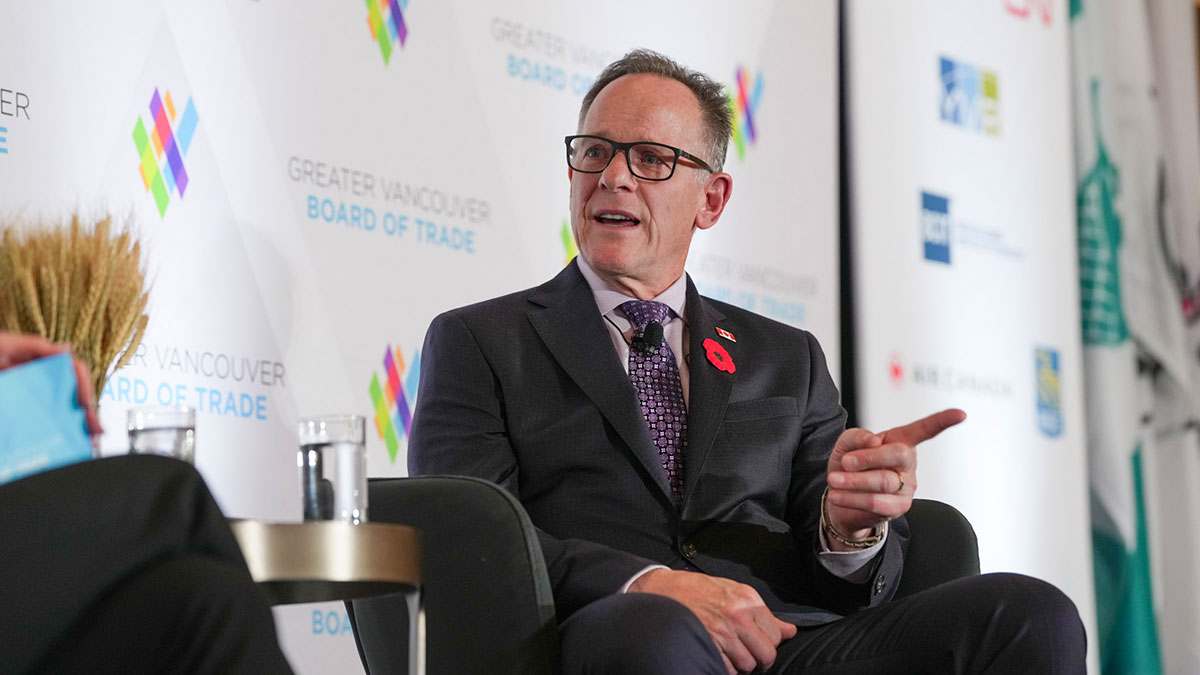
This was Vancouver Fraser Port Authority’s president and CEO, Peter Xotta’s, message to Vancouver’s business community on Nov. 3. Canada has the resources and the customers. Turning that opportunity into lasting prosperity requires the infrastructure to connect them.
Speaking at the Greater Vancouver Board of Trade’s State of the Port event, Xotta made a case for expanding the country’s capacity to trade. The audience’s questions supplied a practical test of that ambition: how quickly can projects advance, and will the investment serve the exports Canada needs to grow?
For Resource Works, these are fundamental questions. Resource development creates lasting value when producers can reach customers reliably, workers can build careers, and communities share in the benefits. Every bottleneck between a mine, farm or mill and an overseas buyer affects that equation.
Roberts Bank Terminal 2: a project of national interest
The Port of Vancouver moves roughly $1 billion in trade every day. Its waterfront connects Prairie grain and potash, Canadian energy and minerals, and manufactured goods with international markets. Xotta recounted Saskatchewan Premier Scott Moe describing Vancouver as Saskatchewan’s port. That’s a striking depiction ofhow much the country depends on decisions made along this coast.
Roberts Bank Terminal 2 is the most prominent next step. On Oct. 30, Ottawa formally listed the Delta container-terminal project as a project of national interest. The federal government estimates it would increase Vancouver’s container capacity by approximately 50 per cent and support up to $100 billion in annual trade.
In the opening of his fireside conversation with Bridgitte Anderson, Xotta described preparatory infrastructure arriving in 2027 and major construction beginning in 2028. Those timelines are important, as Ottawa’s latest announcement identifies 2035 as the target for commercial operations. The years between approval and operation are years in which exporters still need dependable access to customers.
That helps explain the interest in what comes alongside the container terminal.
Gauging priorities: from cruise terminals to bulk exports
Audience questions and comments during the event, included a proposal to consider bulk-export capacity at RBT2, how the Port could speed up its own permitting, and whether the proposed Pacific Link pipeline could be accommodated on the same land.
One of the most popular questions, concerned a second cruise terminal beyond the Lions Gate Bridge’s clearance constraints. Taken together, the questions suggested interest across several industries in whether Vancouver’s infrastructure can keep pace with opportunity.
The bulk-export question deserves particular attention. Grain, potash and petroleum require specialized handling facilities. The federal Gateway Strategy treats container expansion, bulk terminals and industrial land, rail improvements, and environmental protection as connected priorities.
Bridging container and bulk capacity for exporters
There is also a potentially useful connection between container and bulk capacity. Ottawa’s explanation of the RBT2 designation says shifting container traffic toward Roberts Bank could free rail capacity for bulk exporters elsewhere in the port. That would give bulk exporters a potential benefit from the container expansion, alongside investment in their own terminals.
Investment in existing facilities is already advancing. Xotta cited the work at Neptune Bulk Terminals. Canpotex’s September announcement provides the specifics: a $500 million modernization of potash-handling infrastructure, including shiploaders, conveyors and railcar-unloading equipment, with completion expected in 2028. The company says customer shipments will continue throughout construction.
For a Canadian potash producer and an overseas agricultural customer, that reliability has a direct commercial value. It is how a resource advantage becomes a dependable trading relationship.
Addressing bottlenecks: connecting terminals to road, rail, and land
Several audience questions also focused on road and rail bottlenecks, inland transport and scarce industrial land. A larger terminal needs those connections to work. Otherwise, congestion can move from the waterfront to another point in the journey.
Xotta acknowledged that some improvements come from using existing assets better. He pointed to vessel-traffic management, better supply-chain information and dredging at Second Narrows. These measures deserve attention alongside major construction because exporters need improvements while the next generation of infrastructure is being built.
The question about the Port’s own permitting brings the delivery challenge close to home. An institution advocating faster infrastructure development should be able to explain how its own processes contribute to that goal. The practical measures of progress are clearer requirements, predictable decisions and projects moving into service.
Trust and partnership through community and Indigenous agreements
Xotta placed trust and partnership within his account of success, discussing First Nations relationships, listening to neighbouring communities and protecting at-risk whales through the ECHO Program. Ottawa’s project announcement identifies 27 mutual benefit agreements providing opportunities for Indigenous training, procurement, employment and business participation.
Those relationships are critical throughout a project’s life. Communities need confidence that commitments will be honoured as construction advances and operations begin. Environmental stewardship and shared economic opportunity must be visible in how the infrastructure is delivered.
Canada’s ambition to double exports to non-U.S. markets by 2035 gives this work a clear purpose. For resource communities, its value will ultimately be measured in access to customers, investment and durable employment.
“Now comes the part that matters: delivery.”
This was Xotta’s message on the immediate task ahead.
The next evidence of progress should be permits issued, transport bottlenecks removed and capacity brought into service. That is how the ambitions discussed in a Vancouver ballroom become opportunities for Canadians who make, mine, harvest and grow.
Ian Biana writes for the Resource Works Accelerate team and can be reached at [email protected].
Resource Works News