Last year’s Fraser River sockeye bonanza appears to have been a cruel trick of nature that may have given commercial fishermen hope they could go fishing again this year.
This was supposed to be a dominant year for Fraser River sockeye, after all. But 2026 is turning out to be another bust for commercial fishermen.
There will be no openings for Fraser River sockeye this year, the Pacific Salmon Commission confirmed.
The pre-season forecast was for 7.7 million sockeye returning to the Fraser River system. The most recent in-season estimate is just three million, which may not even be enough to meet escapement targets and Aboriginal food fishing allocations.
“We’re seeing very poor returns, and the expectation is we’ll struggle to make escapement targets,” said Greg Taylor, a fisheries adviser for Watershed Watch.
“That means no fishing. That means no recreational, no aboriginal, no commercial. Nobody can fish.”
Adams River sockeye typically make up the lion’s share of Fraser River sockeye in a dominant year, but this year’s returns are looking perilously low.
“If the number turns out to be lower than three million, that would be the lowest in recorded history going back to the 50s,” Dick Beamish, retired DFO biologist and eminence grise of salmon science, told me.
Pink salmon windfall fills commercial void
There have been few bright spots for sockeye and pink salmon in other areas of B.C. that have allowed for some brief commercial openings.

Phillips Arm near Campbell River saw an abundance of pink salmon this year, said fisheries adviser Mike Griswold.
“The seine fleet, we’ve taken a million fish out of there, and this year the price of pink salmon is unprecedentedly high,” Griswold said. “They’re getting $1.75 a pound.”
“It’s turned into a windfall for that fleet. There’s a lot of happy fishermen there, especially because they were counting on Fraser River sockeye this year and it didn’t materialize, so this has filled the void.”
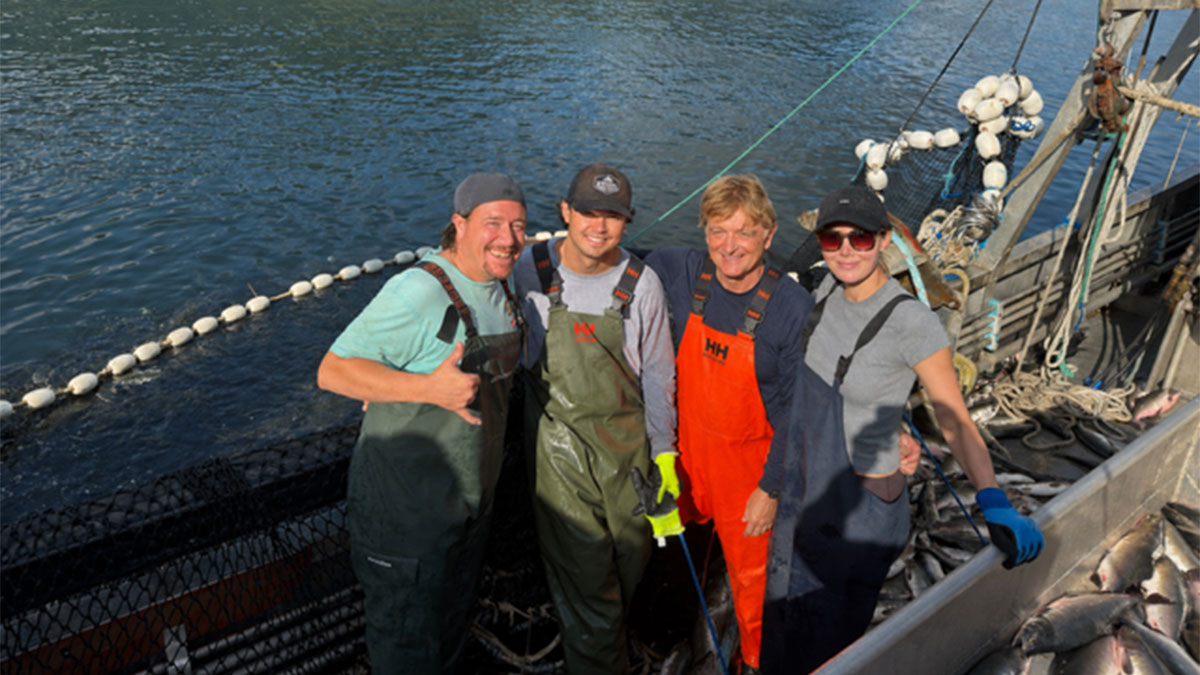
Bob Morreau, a third generation fisherman, said the pinks were a salvation this year. He was able to get in two sets with his seine boat.
“We had like 190,000 pounds of fish in two sets,” Morreau said. “It was actually incredible. There was so much fish that the fleet had to try to make smaller sets.”
The bigger picture of salmon cycle fluctuations
Taylor notes a disparity among four-year-old sockeye—which tend to dominate the Fraser River—and five-year-olds returning to other systems like the Skeena River.
“In the Skeena, the forecasted four-year-olds did not return, but each had a pretty good, strong five-year-old return,” Taylor said.
He said five-year-old sockeye are fatter and “healthier than I’ve ever seen them.”
Most sockeye live for four years, and spend the first two years in local waters and two years at sea. Some can live five or six years.
On the Fraser River, which is dominated by four-year cycle sockeye, returns generally fluctuate in abundance, with one larger “dominant” cycle every four years, followed by a subdominant and two off-year cycles, in which returns are reliably less abundant.
Last year, the dominant cycle seemed to skip ahead one year. The pre-season forecast for 2025 had been for only 2.9 million Fraser River sockeye. Everyone was shocked when they came in three times that size—about nine million.

Commercial fishermen and fisheries managers were unable to respond quickly enough to the unexpected bonanza, and so while there were some commercial openings, fishermen were not able to catch nearly as many fish as they might have.
Griswold, who resigned from the PSC last year in frustration with the way the 2025 fishery was managed, believes part of the problem was that test fisheries are not being properly done. This makes estimating actual returns even less reliable than it already is.
“In retrospect, we had no true snapshot of what was happening,” he said. “Without accurate test fisheries, we’re flying blind. If you do not have accurate information, you cannot, with any assurances, allow any fisheries.”
As for what has caused such a decline in Fraser River sockeye this year, Taylor has a theory.
The fact that five- and six-year-old sockeye returned in good, healthy condition, while their four-year brethren are so few in number suggests something happened in the Pacific in 2024 that made survival tougher for the four-year-cycle fish.
Taylor notes that five- and six-year old sockeye that returned to more northern waters like the Skeena are healthy and fat.
“The five-year-olds are healthier than I’ve ever seen them,” Taylor said. “Those five-year-olds had lots of groceries to eat.”
The four-year-olds, on the other hand, may have had very little to eat, thanks to ocean conditions in 2024—the first year they would have wintered in the open Pacific.
In 2024, unusually warm patches formed in the Pacific, driven by El Niño. These warming events can affect food supplies for fish. Four-year-old sockeye returning this year would have gone to sea in 2024 and may have faced a scarcity of food.
This may explain the disparity between four-year-old sockeye and their fatter, healthier five-year-old brethren.
A crash in some pink salmon populations—notably Prince William Sound—bolsters this explanation. The pink salmon catch there is reportedly down 93 per cent.
Pink salmon live for only two years, and go immediately to sea as fry. So pinks returning in 2026 would also have been at sea in 2024, along with four-year-old sockeye, and may have faced food scarcity.
“We see it in Prince William Sound pinks, we see it with northern pinks, we see it with the four-year-old sockeye,” Taylor said. “The mortality happened all over. It’s not just locally.”
“I think we’re talking something Pacific-wide. When the failure of pinks in Prince William Sound, which is halfway up Alaska, all the way down the Fraser River, we’re not talking about a local event.”
Beamish agrees the 2024 warming event may be at least one of the explanations for the recent declines in certain salmon species.
“The abundance of salmon is mostly determined in the ocean now,” Beamish said.
He points to a crash in Japanese chum in recent years as evidence that ocean conditions are largely responsible for salmon mortalities, as opposed to other potential causes, such as over-fishing, predation or disease from fish farms.
He notes that the Japanese catch of chum in the late 1990s was 270,000 metric tonnes. Last year it was just 16,000 metric tonnes. All of their chum comes from hatcheries, he added.
“There’s no question that the ocean is no longer capable of producing large abundances of chum salmon that enter the ocean off Japan,” Beamish said.
As for other salmon species, there have in recent years been some promising recoveries of coho and Chinook in B.C. waters. The federal government is planning to try to boost that recovery even further.
Last week, the federal government announced $50 million in funding for new hatcheries. The biggest will be a new Chinook hatchery, at a cost of $38 million, on the upper Fraser River near Prince George, with a capacity to rear 400 million Chinook annually.
Beamish thinks new hatcheries could be a good “experiment,” but that it needs to be accompanied with close monitoring—tagging, DNA testing and ocean surveys—to try to determine where the fish are going when they go to sea and how they fare.
“My advice would be—if you’re building that hatchery and spending that money—make sure that you’re putting that money into monitoring,” he said. “Not just how many are released into the ocean, but you monitor how these hatchery fish use the ocean, where they use the ocean.”
Commercial fishing sector still imports resource industry
Though the salmon fishery in B.C. is a shadow of what it once was, commercial fishing in B.C. is still an important industry for coastal communities.
Wild catch fisheries contribute more than $500 million to the B.C. economy, and employ more than 7,000, including in processing.
But whereas salmon was once the most valuable seafood harvested in B.C., it is now eclipsed by crab, prawns and halibut.
According to a Fisheries and Oceans Canada economic snapshot in 2024, crab was the most valuable seafood product, based on wholesale values, at $177 million, followed by prawns ($73 million), halibut ($68 million) and salmon ($55 million).
But the single most valuable seafood export in B.C. is farmed Atlantic salmon. In 2024, farmed Atlantic salmon exports totalled $417 million. That’s the industry the federal Liberal government plans to shut down.
That’s a whole other story.
Nelson Bennett’s column appears weekly at Resource Works News. Contact him at [email protected].
Resource Works News