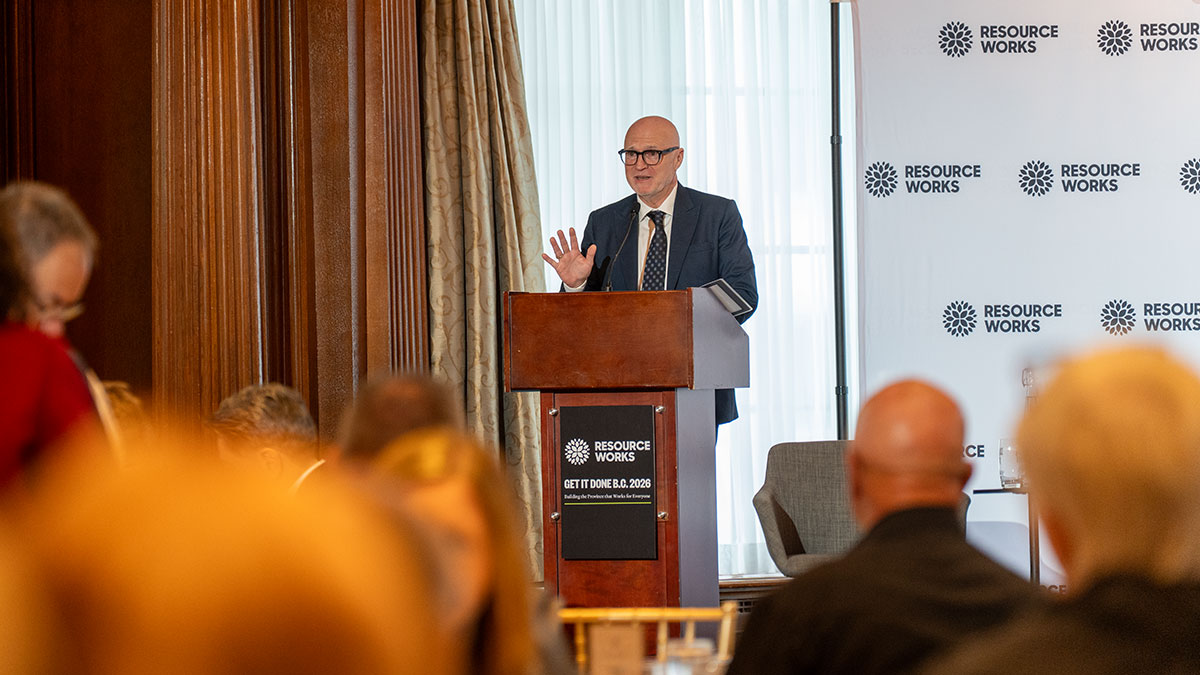
Our second Get It Done B.C. forum opened at the Vancouver Club this morning, the day before UBCM. Eleven sessions between 7:15 and 4:50, with one question underneath all of them: what does it actually take to get a project built in British Columbia?
On the programme today are the Minister of Energy and Climate Solutions, the Leader of the Official Opposition, the leader of the B.C. Greens, a Member of Parliament, and mayors from the communities that produce and ship—alongside the people who finance, permit and build. Resource Works President and CEO Stewart Muir opened the day with thanks to the sponsors who make it possible: gold sponsors the Association for Mineral Exploration and EPAC, silver sponsors TELUS, TC Energy, Cenovus Energy and the BC Salmon Farmers Association, and the supporting sponsors and partners listed below. Resource Works is covering the day as it happens with updates after every session, newest entries first.
4:10 p.m. How the Politics of Energy Must Meet the Times
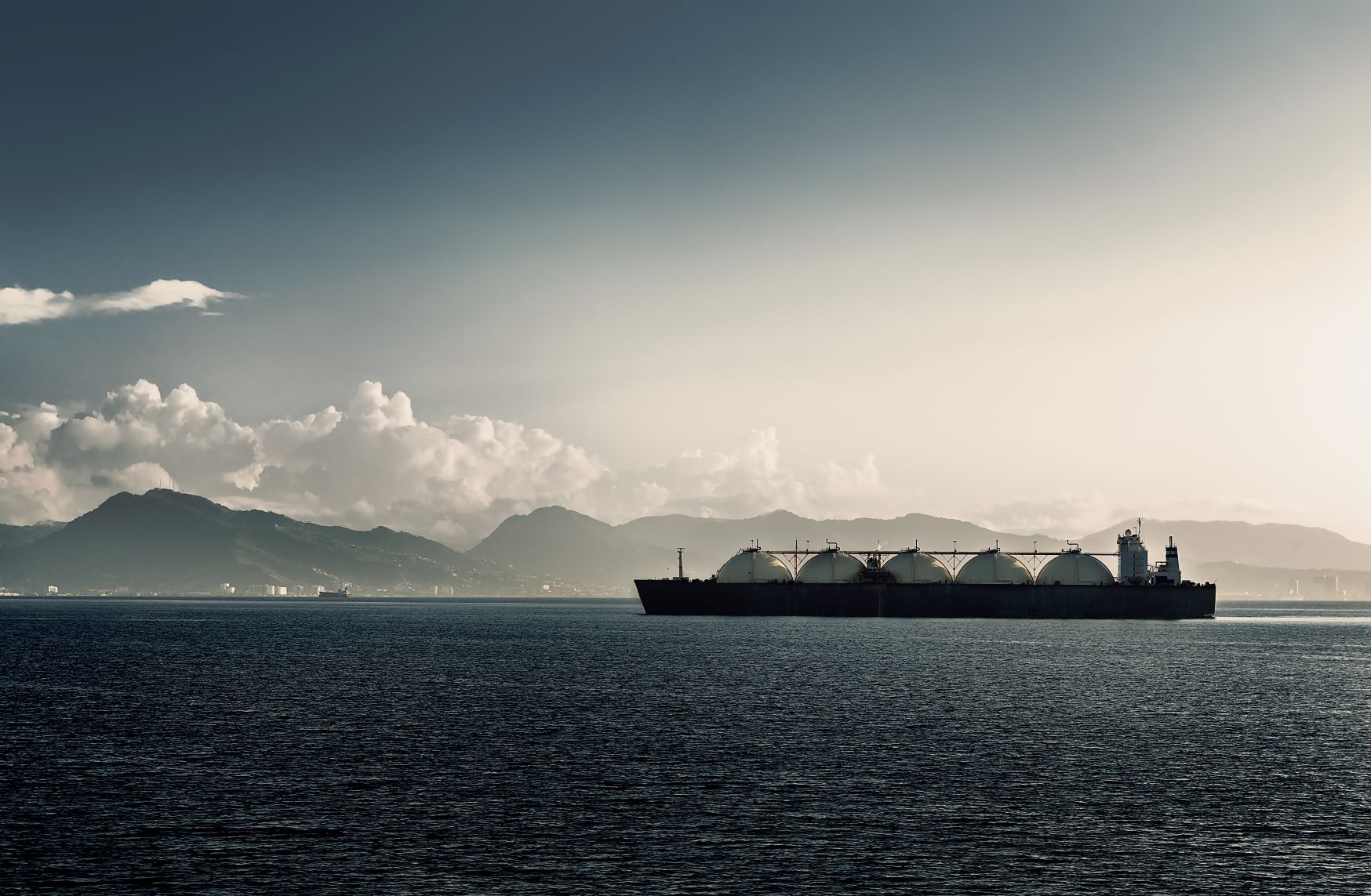
Bryan Cox of Petronas Canada opened the closing session with the numbers behind the day’s dominant subject: more than 50,000 Canadians worked on Coastal GasLink and LNG Canada, and more than 130 cargoes have now shipped.
He had just returned from Japan, where, he said, the question was not whether buyers want Canadian LNG but how quickly they can get it. Barry Penner, KC, Chair of the Energy Futures Institute, and Michelle Mungall, former Minister of Energy, Mines and Petroleum Resources, then moderated themselves through a conversation about how fast the ground has moved.
Penner’s observation was that nobody at the forum had used the phrase energy transition all day. A provincial roadmap in October 2021 described British Columbia as having an abundance of clean electricity; the province has been a net importer for three years since, before a single large AI data centre has been built here. He offered a replacement term that Mungall promptly adopted: energy addition.
Demand rises because energy improves how people live, and the realistic planning assumption is more of it, whatever the source mix turns out to be. Both returned to the gap between political timelines and construction timelines. Site C took fifteen years from Gordon Campbell’s go-ahead to first power last summer, and the site had been identified in the 1970s. BC Hydro’s own modelling says replacing natural gas for home heating would require two more dams of that size.
“The lead time required to catch up to those policies is multiple election cycles and long past anybody’s time in office,” Penner said. On batteries, Mungall made a point of crediting the B.C. Green leader from the earlier panel — someone she disagreed with on much of the day—for raising storage, and said B.C. is not yet using it near its potential. Penner closed by flagging a third annual Ipsos poll on B.C. energy attitudes, due from the Energy Futures Institute later this week.
3:20 p.m. – From Wellhead to Home Cooking: A Mayors Panel
Introduced by Jessica Hunting of TC Energy, the mayors’ panel ran the value chain from the Montney to a Vancouver stove.
Stewart Muir opened by pointing out the window: an LNG bunkering vessel, the Seaspan Baker, was operating a few hundred metres away, making Vancouver the province’s newest LNG city.
Phil Germuth, Mayor of Kitimat, answered the air quality question raised earlier in the day with his own numbers—six monitoring stations, a legacy of the Rio Tinto smelter modernisation, and an air quality health index he says beats downtown Vancouver every day of the year. Kitimat, a town of 9,000 built by the aluminum industry in the 1950s, now produces the greenest aluminum in North America and hosts the lowest-emission major LNG facility on earth. He also addressed the workforce question directly: 7,000 rotating workers in a community of 9,000, managed with a zero tolerance policy that he said worked.
Lilia Hansen, Mayor of Fort St. John, took up the question of who benefits.
“As the mayor of Fort St. John, I can tell you, my hometown does.”
She described projects holding eight of ten permits with no way to plan around the other two—electricity into the Montney or cogeneration using the gas already there, and a long-term care extension for 125 seniors who have been waiting over a decade, currently on pause.
Ken Sim, Mayor of Vancouver, described standardising the city’s building code with the provincial one, restoring natural gas as an option for builders after rules that he said added tens of thousands of dollars to every new unit. His broader argument: “Tax revenue comes from prosperity,” and the province is better served by resource head offices sitting in a jurisdiction with high standards than somewhere without them.
All three returned to the same place on First Nations participation—Germuth on the pipeline capacity LNG Canada made available to the Haisla, which became Cedar LNG, and which he called a gold standard for how these deals get done.
2:25 p.m. – AI Data Centres: Sovereignty and Energy

This panel opened with a concept from Resource Works’ CEO Stewart Muir: compute is a resource.
Moderator Alex Mitchell of the Abbotsford Chamber of Commerce framed it as an infrastructure question. The cloud lives somewhere, and it needs electricity, land, fibre, water and communities.
Keely Hilario of TELUS defined data sovereignty as ownership: knowing where information sits, who can reach it, and under whose laws. Her company’s sovereign AI facility in Quebec, and a coming one in Kamloops, run on 99 per cent renewable energy and 70 per cent less water, with an open-source monitoring model built with the Vector Institute.
Mike Klassen, Vancouver City Councillor, noted that this morning’s polling put public sentiment on data centres somewhere below oil tankers, and described the city’s own early use of the technology—an AI tool that runs building plans and returns variances immediately, work that previously took days or weeks.
Shani Gwin, founder and CEO of wâsikan kisewâtisiwin—Cree for kind energy—brought the OCAP principles developed by the First Nations Information Governance Centre into the frame, and made the case that Indigenous data governance is now everyone’s problem rather than a niche one. Her company is building consent into each layer, including a royalty model: when community information is used, the community is paid. “
“There’s an opportunity to build on real economic reconciliation through AI.”
The sharpest question came from the floor, and nobody entirely answered it: data centres sit in the same property tax class as coffee shops and employ few people, while drawing the power of a major mine that employs hundreds. Klassen’s answer pointed upward, to the provincial and federal governments, while noting that industrial land is already in short supply, the same constraint Brad West raised earlier in the day.
1:40 p.m. – Keynote and Q&A with Hon. Adrian Dix

The Hon. Adrian Dix, Minister of Energy and Climate Solutions, delivered the keynote address of the day, followed by a conversation with EPAC President and CEO Tristan Goodman.
His argument was that the era of coasting on the American relationship has ended. 51 per cent of B.C.’s trade still goes south, the lowest share in Canada, but the assumption underneath it is gone. The answer is to upgrade the value of what the province owns and sell it more widely.
He put numbers to what that has produced: from no LNG exports before 2025 to the sixth-largest LNG producer in the world by 2030, and fourth by 2035, ahead of Russia and Malaysia. Six proposals sit at or near final investment decision. He credited the companies and, repeatedly, the nations—Ksi Lisims as a Nisga’a project, Cedar LNG majority-owned by the Haisla, Woodfibre built in partnership with the Squamish, Musqueam with Fortis at Tilbury, 38 First Nations across the midstream.
That led to his sharpest line of the afternoon, aimed at an argument that has run through the whole day.
“People say to us, ‘Can’t invest in BC because of the First Nations issues.’ They are wrong.”
Abandoning DRIPA and reconciliation while expecting the same investment, he said, would be historically naive. On electricity, BC Hydro is planning for a 50 per cent demand increase after two decades of flat demand, with 14 electricity purchase agreements signed with independent producers in partnership with First Nations and first construction in 2026, and the Clean Energy Act amended this fall to let previously excluded options be considered.
He also reached across to the sector that dominated the morning saying, “Forestry is BC’s most important industry,” adding that because the towns are where they are because of forestry, and neither American duties nor Chinese dumping can be allowed to end it.
On regulatory churn he was self-critical about his own party’s record—92 bills in its first year in office in 1991, 74 the next, 54 the year after—arguing that industry and society cannot absorb change at that rate, and that a new royalty system taking effect on 1 January 2027 needs to then stay put. He closed on young people, and on a generational obligation to make sure the opportunities in Kitimat reach people from Kitimat.
1:35 p.m. – Remarks by BCER CEO

“Our approach is not to be an aloof regulator.”
Michelle Carr, CEO and Commissioner of the BC Energy Regulator, spoke between panels to describe an agency whose mandate now runs well past oil and gas, to geothermal, carbon capture, hydrogen, wind, solar and transmission lines all sit with the single-window regulator.
Her headline figure spoke to complaints heard repeatedly earlier in the day: average oil and gas permitting timelines have been cut by 50 per cent since 2023, including archaeology decisions under the Heritage Conservation Act, with environmental review and input from First Nations, local governments and communities still in place.
The regulator has issued its first decisions on North Coast Transmission Line authorities, and its renewable energy framework arrived within months of the legislation, with first decisions due this fall. For the municipal audience, one change in particular: companies are now required to engage local governments before applications reach the regulator.
12:30 p.m. – From City Hall to Parliament Hill

This was the panel the room had been waiting for, and the one that carried on in the room immediately afterwards.
Jason Pires of Global BC opened by reading Brad West his own 2018 quote about colleagues “completely detached from reality” on resource development, and asking whether anything had changed.
The Mayor of Port Coquitlam said it had. That a strong Canadian economy has been rediscovered—though it took an autocratic neighbour to do it—and put numbers to what is at stake for workers: the average wage in B.C.’s tourism sector is about $24 an hour, against about $68 in the resource sector, with union coverage, pensions and job security attached. On transition, his challenge was specific: the replacement jobs are described but never located.
“Where are they? What do they do? What do they pay?”
Emily Lowan, Leader of the B.C. Green Party, disputed the premise rather than the ambition. “I’m not a no person. I just don’t like what you’re proposing.” Her questions were about ownership and distribution. Who owns the resources, who benefits, and who is left carrying the bag, and she pointed to a global LNG supply glut in five to eight years, to renewable projects struggling for support, and to a First Nation near Kamloops that needed a court case and 14 years to build B.C.’s first utility-scale solar project.
Ellis Ross, MP for Skeena–Bulkley Valley and former Haisla Nation chief councillor, located the problem in politics rather than process. Germany built an LNG terminal in two years, he said; Canada spent twenty trying. Chevron walked away from a $30 billion project. What made LNG Canada different was a decision at the band level “to stop talking, stop analyzing, and start doing.” Asked whether he had ever seen genuine alignment across municipal, provincial and federal decision-making, his answer was one word: no.
Read more: The certificate nobody signs
12:20 p.m. Special Lunch Address

Gavin Dew, MLA for Kelowna-Mission and finance critic, delivered the lunch address, opening on the time horizons the resource sector actually works on: his first summer job was photocopying files at an engineering firm two blocks from the Vancouver Club, and the boxes were Mount Milligan and Red Chris—both studied for decades before they produced anything. Red Chris still has a major phase ahead of it.
Mining, oil and gas generate more than three times the economic output per hour of the provincial average, he noted, and resources account for roughly three-quarters of B.C.’s goods exports. His central argument was about execution rather than intent: the question is no longer whether to build but whether it can actually get done, and capital responds to conditions rather than announcements.
“British Columbia has often become the land of the slow maybe. Not no, just maybe, slowly. For investors, that can be as damaging as an outright no.”
Investors can price a tough rule, he said; what they cannot price is unpredictability.
He offered a timeline comparison from his three years working on the Trans Mountain expansion. The original line crossed two mountain ranges in 18 months using 1950s technology for $93 million, while the expansion took more than a decade and $34 billion.
On forestry, he echoed a point made earlier in the day: American duties and tariffs are damaging, but the homegrown costs are ours to fix, and B.C. should be creating private sector jobs logging and managing forests rather than only public sector jobs fighting fires. He also picked up the theme Mayor Angela Brand Danuser raised in the mining panel—that communities hosting growth carry the costs first while the fiscal upside flows to Victoria—proposing a municipal growth dividend so communities share directly in what they help generate.
10:55 a.m. – Minerals for Tomorrow

Introduced by Sean Magee of Trekor Metals, the mining panel spent most of its time on the clock rather than the geology.
Chuck Downie, President and CEO of Eagle Plains Resources, walked through what it now takes to get from interest to fieldwork in B.C.: since the Gitxaała decision, staking a claim online has been replaced by an application process that averages 222 days, followed by 18 months to two years for a permit—up to three years in total before meaningful work can start. In Saskatchewan, where half his projects are, the same process takes 90 days.
Moderator Jack Middleton, Vice President of Policy at AME, noted that B.C. set a record for exploration spend last year and Saskatchewan still moved past it into third place.
Greg Bury of Finning Canada, who works across five western jurisdictions, was less than flattering: B.C. is the busiest mining province outside the oil sands and close to the hardest to do business with, and the other provinces have found a clarity of path B.C. has not.
Angela Brand Danuser, Mayor of Stewart, brought the municipal end—a town of 500 people that swells each summer with exploration crews, where each truck running through to the Portland Canal terminal carries about a million dollars in ore, and where the health centre is funded on the census number. Her ask was that the Resource Benefit Alliance be signed in perpetuity rather than renewed in five-year terms. Downie’s warning was longer-range: a permit now costs $50,000 to $80,000 to assemble, which is manageable for a public company and impossible for an independent prospector. “In another 10 years, if things don’t change, there won’t be any prospectors left.”
Read more: Seven months to stake a claim in B.C. Ninety days in Saskatchewan
10:20 a.m. – Forestry is a Solution: B.C.’s Homegrown Advantage

Fifteen forestry associations, including organized labour, wrote to Premier Eby last week with a single line at its centre: “BC’s forest sector is at a breaking point.”
Moderator Cam McAlpine, Principal at Pendulum, opened on how it got there.
Kim Haakstad, CEO of BC Council of Forest Industrues, said blaming the U.S. trade dispute oversimplifies it. B.C. has gone from the most affordable jurisdiction in the country to do forestry to the highest-cost in North America, and no trade outcome fixes that.
Peter Lister, CEO of the Truck Loggers Association, put a number on the part within provincial control: the cost of obtaining a cutting permit has risen from $4 to $14 a cubic metre, the product of more than 50 changes to legislation and policy. At the current harvest of about 30 million cubic metres, that is roughly $300 million in added cost that creates no value. Government approves permits in 20 days, he noted, but the full process can take two to three years.
Both pushed back on the idea that a smaller sector is a safer one. Haakstad: the B.C. Interior produces enough dimensional lumber annually to build about 155,000 homes, in a province and a country short of housing, and B.C. harvests roughly one-third of one per cent of its forested land base each year. Lister pointed to California, which wound down its forest industry and then carried about a billion dollars in wildfire mitigation costs on taxpayers before rebuilding the sector to do the work commercially.
The panel’s three asks of government: a forest sector crisis action team spanning government and industry, no further fee or permitting increases, and policies that get the wood out.
9:20 a.m. – The Power of Yes: Local Benefits and Community Voices

Shannon Joseph, Chair of Energy for a Secure Future, presented new research before moderating the panel—a study conducted with iTOTEM Analytics tracking 20 municipalities and 21 First Nations along the LNG Canada and Coastal GasLink corridor against the five conditions B.C. set for LNG.
The baseline was a gap: household incomes about $6,000 below the provincial average, more housing in need of major repair, post-secondary attainment 15 per cent lower and flat. What followed the projects: after-tax household income in the corridor up 34 per cent, from $78,000 to $105,000; registered nurses per 100,000 people up from 609 to 727; more than 75,500 jobs across both projects, 1,300 people trained, over 750 scholarships.
First Nations own-source revenue rose 159 per cent and now makes up more than a third of operating budgets—money spent on housing, education and community programs without reference to Ottawa. Joseph’s argument was that none of it was inevitable: had the blockades succeeded, the training, the income increases and the majority Indigenous-owned Cedar LNG project would not exist.
Chief Roland Wilson of West Moberly First Nations, chief since 2000, described a nation that watched development pass it by until the courts opened a door.
“We’re not opposed to development. We’re opposed to the unnecessary impacts of it, and we can limit that by getting involved.”
Karen Ogen, CEO of the First Nations Natural Gas Alliance and a former Chief of Wet’suwet’en, spoke about her community’s reality before and after it had a stake in these projects
“We managed poverty. We took our Indigenous Services Canada’s money and managed poverty.”
Today her community has paved roads, more housing and money for social programs—after, as she put it, 600 court cases.
8:45 a.m. – Resource projects and the Path to Partnership

The first panel took on the year since the Cowichan decision. Moderator Margareta Dovgal, Managing Director of Resource Works, opened on the anger in the province—some of it legitimate, some of it alarmism—and asked where it comes from.
Malcolm Macpherson, partner at Macpherson Law and a Resource Works board member, put the blame elsewhere than it has been landing.
“A lot of the First Nations in BC are getting the finger pointed, especially post-Cowichan and other rulings, and it’s just not fair. It’s a form of scapegoating.”
The economy, he argued, is where you look for the causes. Á’a:líya Warbus, independent MLA for Chilliwack-Cultus Lake and a member of the Stó:lō Nation, traced the anger to scarcity—groceries, housing, the certainty of what people own—and warned against “simplistic conversations about complex issues.”
Warbus made the case for transparency: one nation’s title area may be the size of a country while its exclusive jurisdiction is about two per cent of it, and the public cannot be brought along on facts it has never been shown.
Both landed in the same place. Macpherson: nations with settled treaties will be the ones unlocking resource development, and industry should see them as allies. Warbus: the momentum gets built by sharing what has already worked—”copy and repeat, steal a great idea.”
8:35 a.m. – The proof is in the numbers

Mike Witherly, partner at Fairview Strategy, opened the day with the exclusive release of new provincial polling conducted with Avatar Innovations—just under 900 British Columbians surveyed online in July, margin of error 3.2 per cent.
Cost of living remains the top issue looking out over the next decade, as it has been since COVID, and the mood underneath it is sour: nine per cent say the province is definitely headed in the right direction, against roughly 22 per cent at the opposite end. What has moved is infrastructure. Support is at what Witherly called a remarkable point—about a quarter of British Columbians still oppose port facilities for oil tankers, but only nine per cent strongly oppose, which he said is new. His explanation is that each project built makes the next one easier, because it stops being an unfamiliar proposition.
“At the end of the day, they built all these things, and the world hasn’t ended.”
He described a province holding two views at once—roughly 70 per cent agree natural resources matter to B.C.’s prosperity, and a comparable share agree with fairly hard-line environmental statements—and a new answer surfacing in focus groups when he asks whether changed standards are a problem: “we’re green enough.” On what the public wants done with resource revenue, using it to fund services drew overwhelming support, and Witherly’s read is that British Columbians want action on it more than they ever have.
8:25 a.m. – Opening remarks
Richard Prokopanko, Chair of the Resource Works Society, and Kermit Dahl, Mayor of Campbell River and Chair of the Alliance of Resource Communities, set the terms for the day from the municipal side. Mayor Dahl highlighted how resource revenues pay for hospitals, schools, roads and services across the province, he said, and good jobs let young people build lives in the towns they grew up in—but none of that means saying yes to everything.
“It means creating a system where good projects can get to yes, where the rules are clear, decisions are timely, environmental standards remain strong, First Nations are meaningful partners, and investors know that British Columbia is actually open for business.”
Municipalities have to be in that conversation, Dahl argued, because they are the ones hosting the projects and providing the roads, infrastructure and services around them—the reason the Alliance of Resource Communities was formed in the first place.
He closed on what is leaving: “For too long, one of our greatest exports has been our younger generations. Our kids, our grandkids, are leaving the communities they grew up in to find opportunities elsewhere.” His challenge to the room was to keep the day practical. “We’ve spent a lot of time talking about what British Columbia could do. It’s time to figure out what we will do, and then get it done.”