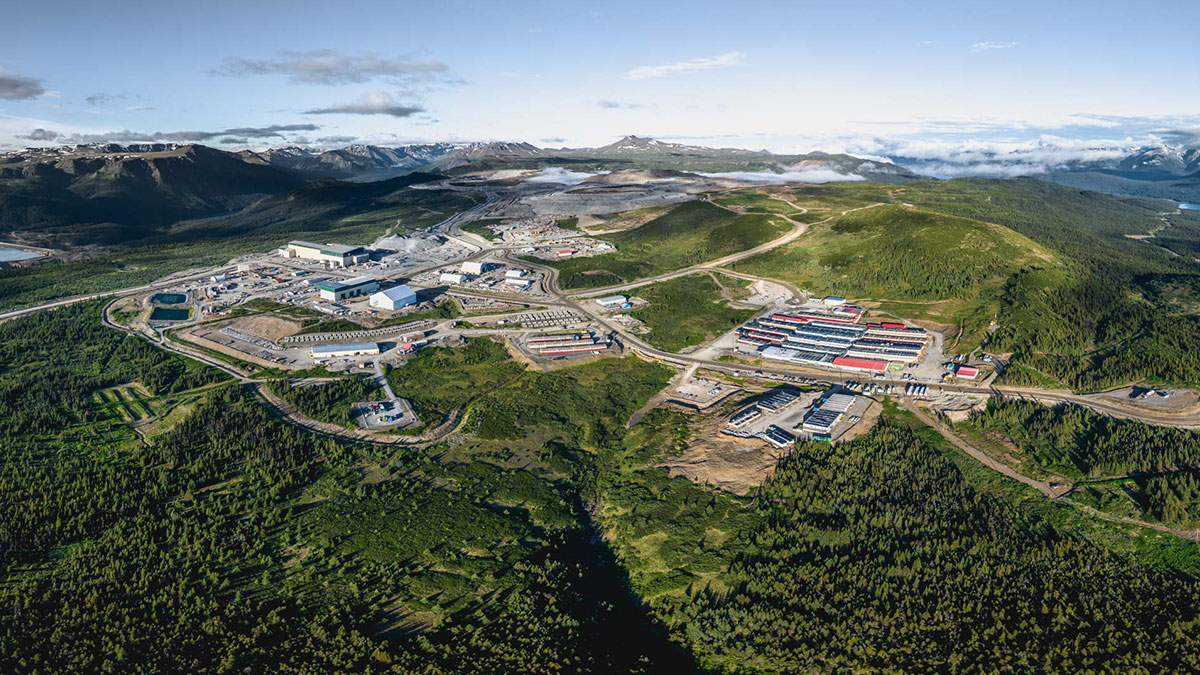
Sometime in the New Year, Newmont and Imperial Metals plan to pull the trigger on an expansion of the Red Chris gold-copper mine in northwest B.C. that will represent the single largest investment in mining in B.C. to date, and the second largest in Canada.
Only the massive KSM mine, now estimated to cost $9 billion to build, would eclipse it in terms of capital costs for a B.C. mine project.
In its recent third-quarter financials, Newmont confirmed an updated capital cost estimate of $5.8 billion to $6.7 billion (US$4.2 billion to US$4.8 billion) for the expansion project, which will see the mine transition from open pit to underground block caving.
“It’s a multi-generational mine that will provide a good stable supply of copper that supports Canada’s position as a leading and growing copper exporter,” said Michael Goehring, president of the Mining Association of BC.
“B.C. is Canada’s largest exporter of copper and this project will increase Canada’s copper output by some 15% per year.”
Newmont is finalizing a feasibility study and plans to make a full funding decision in early 2027.
Earlier this year, the project received all necessary regulatory approvals, including a consent agreement with the Tahltan First Nation. Red Chris currently employs about 190 Tahltan members.
“We’re quite excited about this project,” said Todd Den Engelsen, CEO of the Tahltan Nation Development Corporation (TNDC). “We’re hoping it goes through because it does provide a lot of immediate and long-term benefits to the nation.”
Because it produces copper – considered strategically important – the Canadian government designated Red Chris’s expansion to be of national interest through a Major Projects Office listing and has provided the project with $500 million in funding.
Newmont estimates recoverable resources of 3 million ounces of gold and 850,000 tonnes of copper.
Once in operation, it would produce 275,000 to 325,000 ounces of gold annually, and 65,000 to 85,000 tonnes of copper – making it the second largest copper producer in B.C., next to Highland Valley Copper.
Newmont, the world’s largest gold miner, owns about a dozen operating mines around the world, including two in B.C. – Brucejack and Red Chris. It also owns a 50 per cent share in the Galore Creek project.
Red Chris was the headline item of Newmont’s recent third quarter results. It describes Red Chris as “a rare, large-scale multi-decade gold-copper opportunity.”
Red Chris nears end of mine life
Imperial Metals put Red Chris into operation in 2015. Newmont acquired a 70 per cent interest in Red Chris, through its acquisition of Newcrest Mining in 2023, leaving Imperial with 30 per cent.
The original ore body, targeted as an open-pit mining operation, is now nearly mined out. It is expected to be depleted by 2028.
But there is a large gold-copper porphyry deposit further below what is currently being mined.
Reaching it would require either expanding the open pit and going a further one kilometre deeper, or going underground. Newmont opted for block caving.
Not all geologies are suitable for block cave mining, and not all companies have either the expertise or financial wherewithal that Newmont does.
With a market cap of US$121 billion, Newmont is the world’s largest gold miner, and has already built block caving operations in Australia.
A block cave mine is expensive to build, but cheap to operate. All the capital investment comes up front, as all the underground workings must be built before extraction starts.
But once in place, it becomes a much more efficient way of extracting ore, and it would have a comparatively low annual operating cost. Newmont expects Red Chris to be one of its lowest cost operations over life-of-mine.
The deposit that will be targeted – a macro-block – has an estimated mine life of 17 years. But since all the underground infrastructure will be in place, once that macro-block has been exhausted, the company could just move onto other macro-blocks.
Newmont estimates Red Chris could be extended this way, sequentially, for up to 70 years.
Block caving lets gravity do the work
Block cave mining involves tunneling underneath the targeted ore deposit then mining it from the bottom up. This video illustrates how the process works.
Underneath the ore body, a large cavern is created, and then miners drill upwards into the ore body and begin to undermine the rock.
Weight and gravity then take over, and the rock above begins to crumble down. It’s basically a controlled cave-in that eliminates the need for a lot of drilling and blasting.
The rock is collected in drawbells and transported to an underground crusher. The crushed rock is then sent to the surface on a conveyor system, where it is then processed into a concentrate. The concentrate is shipped overseas through the Port of Stewart.
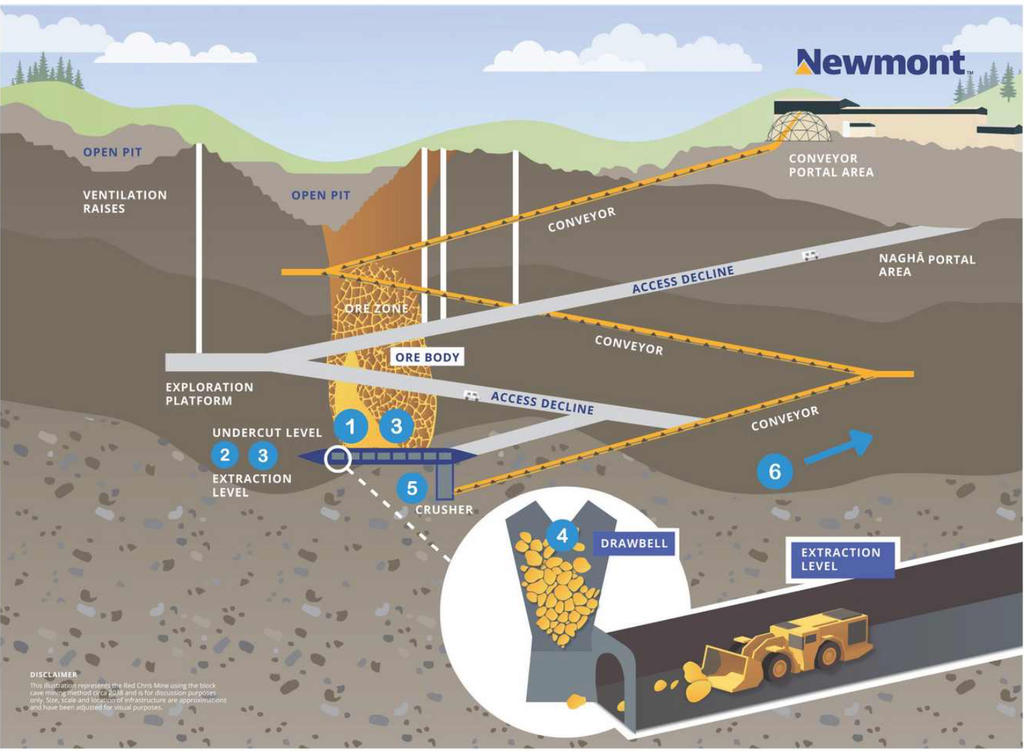
Block caving eliminates the need for a large fleet of diesel-powered haul trucks and excavators, which is expected to result in an 80 per cent reduction in carbon emissions.
Some jobs, like haul truck driving, would be eliminated, but others created – such as conveyor operators. This will require upskilling and retraining of the current workforce.
The workforce, which includes a number of Tahltan First Nations members, is expected to increase from about 1,500 to 1,800 during construction.
“This is going to be a change to our workforce – from above-ground to predominantly underground,” Den Engelsen said.
“We will be investing in training programs. Our underground partner – well-versed in this – has training facilities around the world.”
Some preliminary tunneling has already started. Once a full funding decision is taken, Newmont expects to start construction in earnest in 2027. The company expects production to start in 2033.
Nelson Bennett’s column appears weekly at Resource Works News. Contact him at [email protected].
Resource Works News