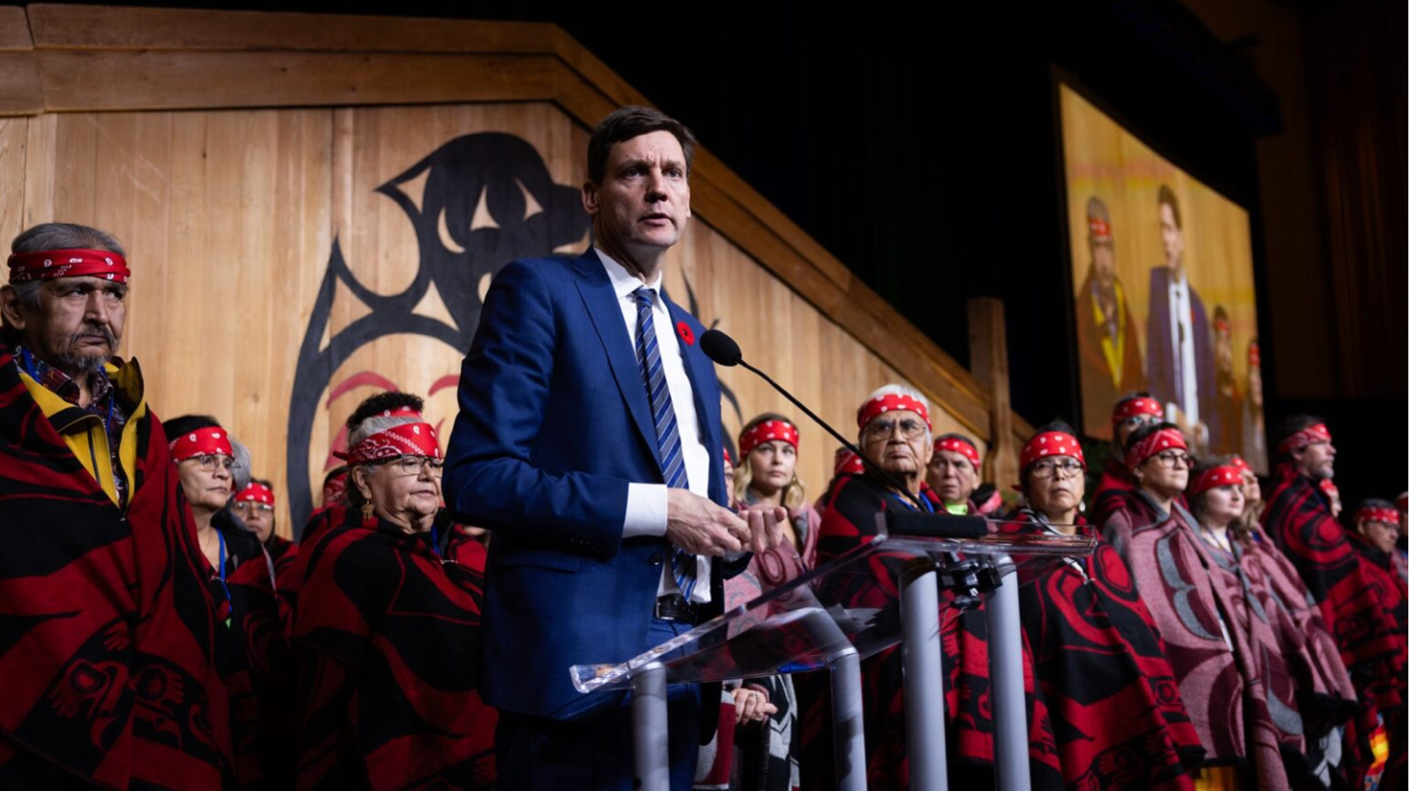
Caught between a rock and a hard place on a major First Nations issue, BC Premier David Eby has backed down.
Instead of going ahead with the contentious suspension of some parts of his government’s Declaration on the Rights of Indigenous Peoples Act, the DRIPA Act, Eby is shelving the suspension legislation he had planned.
Instead, he says, he may extend the current legislative session in the hopes of finding support among individual First Nations for some new suspension plan.
Thus he no longer faces a non-confidence vote in the legislature, where his New Democratic Party has a majority of only one seat — and where one Indigenous NDP MLA had denied him support, and two other Indigenous NDP MLAs were being urged by First Nations to vote against him.
Changing the math
Indeed, said Eby, as he announced his new plan, Indigenous MLA Joan Phillip, a New Democrat and a parliamentary secretary, had told him she could not bring herself to vote for the suspension. That, said Eby, “obviously changes the math” for the party.
MLA Phillip is the wife of Grand Chief Stewart Phillip, one of several members of the First Nations Leadership Council who had condemned the planned suspension of some DRIPA provisions.
Eby says his government’s relationship with the council is “under significant strain” right now, but he hopes to deal directly with First Nations leaders and groups to find a path forward for some suspension plan.
The initial rock Eby had faced was BC’s adoption in 2019 of the DRIPA Act, and a court ruling last December that the act should apply to all BC laws and “with immediate legal effect.”
The looming hard place was First Nations opposition to his proposal to suspend some provisions of the DRIPA Act, and the non-confidence vote he was planning.
The DRIPA Act aimed to ensure that BC laws were consistent with the United Nations Declaration on the Rights of Indigenous Peoples (UNDRIP). Those UN rights include the principle of free, prior and informed consent of Indigenous Peoples to natural-resource projects on their territories.
The rock and the hard place
The 2025 court ruling was on a challenge by the Gitxaala and Ehattesaht First Nations to BC mineral-claims procedures. In it, the BC Appeal Courtsaid DRIPA should be “properly interpreted” to incorporate UNDRIP into all BC’s laws — and “with immediate legal effect.”
Eby had said that the court ruling would mean his government would have to apply UNDRIP to all BC laws all at once. “Instead of eating the elephant one bite at a time, the court has invited us to do it all at once, and that is just not possible.”
He now says more than 20 lawsuits against the province have been amended to reflect the court ruling.
Eby had said suspending problematic sections of the DRIPA Act would be the “least invasive” way of mitigating the act’s unintended impact on BC laws as a whole.
He had said at the same time that the move would be subject to a confidence vote in the legislature.
But Robert Phillips of the First Nations Summit had said such a vote would be the time for the three Indigenous MLAs in Eby’s NDP government to either “not show up” or to vote against the relevant legislation.
The premier had not said which sections of the DRIPA act he would suspend, and he said other sections would remain in effect, including those that allow the government and First Nations to sign resource agreements.
Mounting First Nations opposition
Eby’s initial proposal for suspension for up to three years had been quickly and roundly hammered by First Nations.
Phillips said leaders had been “clear and resolute” that they do not support any backing down or pause on reconciliation. “Fundamentally, First Nations cannot afford to ‘pause’ efforts to protect their title and rights.”
At least 100 First Nations and Indigenous groups had voiced opposition to any changes to DRIPA, saying changes would water down the government’s commitment to reconciliation.
And the First Nations Leadership Council had come out strongly ripping Eby’s proposal to suspend key provisions of DRIPA as “a unilateral betrayal and an abandonment of the province’s commitment to principled reconciliation.”
The council added: “First Nations will not agree to any unilateral legislative proposal that puts legally required reconciliation work on hold and undermines our inherent and constitutionally protected title and rights.”
Earlier, Robert Phillips of the First Nations Summit said amendments would “gut” DRIPA and turn back the clock on relations between the provincial government and First Nations by decades. And some Indigenous leaders had protested “shambolic and insufficient dialogue meetings that have not allowed most chiefs to speak.”
Eby acknowledged that the previous plan to redraw DRIPA had proven “totally unacceptable” and “offensive” to First Nations. Some First Nations had protested “shambolic and insufficient dialogue meetings that have not allowed most chiefs to speak.”
The premier had then said he hoped First Nations leaders would at least tolerate the planned three-year pause as the government appeals the Gitxaala/Ehattesaht court ruling to the Supreme Court of Canada. That pause now is on hold.
Eby had not identified which sections of DRIPA would be suspended, adding that other sections of DRIPA would remain in effect, including those that allow the government and First Nations to sign resource agreements.
Over to Eby now to work with Indigenous leaders and groups in some much less “shambolic” dialogue.
Don MacLachlan is a writer for Resource Works, a non-partisan organization that champions responsible resource development in British Columbia and Canada. Reach him via [email protected]
Resource Works News