
Prime Minister Mark Carney has a lot on his plate right now, so he may not even be aware that an entire industry in B.C. is about to collapse, thanks to his predecessor, Justin Trudeau.
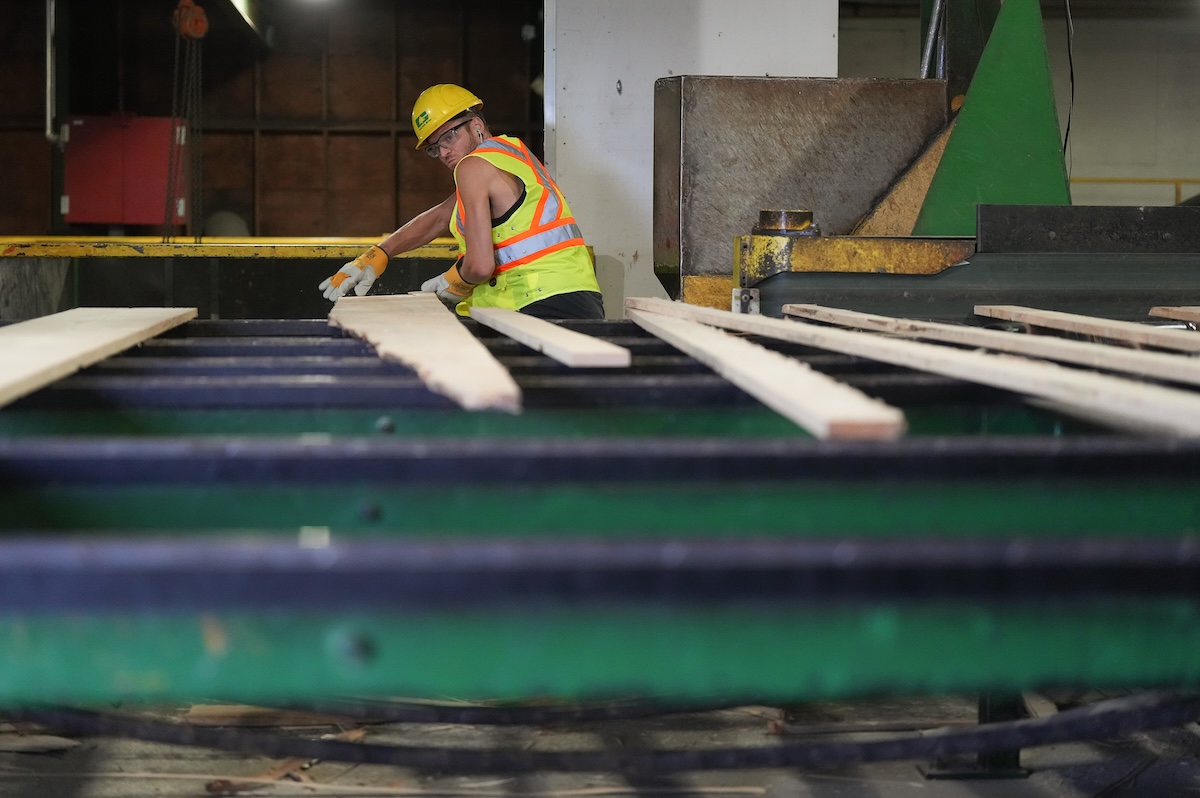
When it does collapse, it will take with it more 4,000 jobs and dozens of service businesses – many of them in small coastal First Nation towns and villages like Klemtu and Port Hardy.
The clock is ticking on a three-year planning cycle for salmon farming operations in B.C., which must start buying eggs now if they are to have a harvest three years from now.
But three years from now, all open-net salmon farms in B.C. must be shut down, unless the Carney government has second thoughts about Justin Trudeau’s ban on open-net salmon farming in B.C.
Millions of juvenile salmon will have to be euthanized – as already occurred in 2021 with the phase out of salmon farms in the Discovery Islands area – and more than 4,000 jobs will disappear overnight.
The collapse, when it comes, will happen quickly. As salmon farms shut down, a range of businesses that serve the industry – feed suppliers, barging operations, net cleaning services, water taxis – will be pulled under.
“The companies made it very clear to the federal government in June that…millions of dollars had to be spent that was post-2029,” said Brian Kingzett, executive director for the BC Salmon Farmers Association (BCSFA).
“And the companies have said, if we don’t have a repeal of the ban and something that is mutually workable, that they’re leaving Canada – full stop.”
One major player, Grieg Seafood, has already left B.C. Last year it sold its B.C. assets to Cermaq.
Contracting production and coastal job losses
The B.C. salmon farming industry has already contracted significantly, as a direct result of the Trudeau Liberal government policies.
A federal ban on open-net salmon farming started with the Discovery Islands region, where federal licences were not renewed.
Dozens of salmon farm operations have shut down in the Discovery Islands, Broughton Archipelago and Sechelt area since 2019.
Production of farmed salmon – B.C.’s most valuable seafood export – is now down from 90,000 tonnes per year to 55,000 tonnes, and 1,500 jobs have already been lost, according to BCSFA.
First Nations that are invested in salmon farming will be particularly hard hit. For some, it’s the only industry they have left that provides year-round work.
At a press conference in Ottawa Wednesday, members of the Kitasoo Xai’xais from Klemtu spoke about the positive impacts salmon farming has had for the community, and the negative impacts that will result from the Trudeau ban, if it’s not repealed.
They talked about the social crisis their people faced, including high suicide rates, as a result of poverty, which salmon farming helped address.
“Salmon farming brought jobs, food, and certainty for our people,” said chief councillor Chris McKnight. “And if the net pen ban is not reversed, this will be taken away. We are seeing these social crises already return.
“The federal government cannot say that it wants First Nations to become partners and owners in Canada and major economic projects, and then tell coastal First Nations that we cannot make responsible decisions about salmon farming in our own waters.”
“We face an avoidable, escalating economic crisis in our communities, and we are already seeing it in regards to social effects of the short-term and permanent job losses,” said deputy chief councillor Isaiah Robinson.
“Our message for Prime Minister Carney and the government of Canada is simple,” Robinson said. “We must end this Trudeau-era policy and reverse the open-net salmon farm pens.”
The First Nations Wild Salmon Alliance (FNWSA) was also in Ottawa the same day, urging the Carney government to maintain the ban.
“We want the government to be clear that there is broad support for this initiative,” said FNWSA chairman Bob Chamberlin.
The FNWSA and others blame fish farms for declines in wild salmon, due to disease and sea lice transmission – a link that is not clearly demonstrated by marine science.
Despite advice from Department of Fisheries and Oceans (DFO) scientists that salmon farms posed no more than a “minimal risk” to wild fish, former Fisheries Minister Diane Lebouthillier issued a fiat in 2024 requiring a “transition” of open-net salmon farms from B.C. waters by 2029.
Economic viability of closed-containment technology
The land-based systems that had been promoted as an alternative have failed to materialize, as they are simply not economically viable. There are no proposals for any large land-based farms in B.C.
Companies have been experimenting with hybrid-systems that offer partial containment to address concerns about disease and sea lice. But it’s not clear whether these systems would ever be approved under the current policy – at least not in B.C.
There are also ocean-based full containment systems being developed. One such system could end up being fabricated in Campbell River.
Bluegreen, a Norwegian aqua-tech company, is proposing a $51 million investment in Campbell River to manufacture its Marine Donut system.
The technology is a floating, fully contained torus shaped system manufactured from high-density polyethylene (HDPE).

Seawater is drawn from a depth of about 40 metres down and circulated around the large torus that contains and isolates the fish. Sea lice tend to occur at shallower depths, so sourcing the water from lower depths eliminates the chance of sea lice getting in with the fish. Fish offal and food waste is captured.
With the support of the City of Campbell River and Wei Wai Kum First Nation, Bluegreen is a $51 million investment in a Marine Donut fabrication plant in Campbell River. The project is getting $14 million in funding from Canada’s Ocean Supercluster.
The investment includes training local people in the HDPE production and fabrication. The plan is to manufacture the facilities in Campbell River for the North American market.
The irony is that Campbell River could become a fabrication hub for a technology that will never be used in B.C.
I can’t imagine any aquaculture company investing millions of dollars in a region where the salmon farming industry has been deliberately shut down by the federal government.
The $1-billion economic risk for B.C.
It is encouraging for the Canadian economy that Mark Carney has repudiated and rescinded some of Justin Trudeau’s more economically ruinous policies.
The salmon farming industry is hoping he likewise rethinks Trudeau’s salmon farm policies which, it must be noted, apply only to B.C., and not to Atlantic Canada, where salmon farming is growing.
Asked if Joanne Thompson, Minister of Fisheries and Oceans, will be reconsidering the ban, DFO media relations responded:
“Any future decisions related to salmon aquaculture transition in British Columbia will be communicated by the Government of Canada in due course.”
Which means that, if we don’t hear anything different from the minister in “due course,” B.C.’s salmon farming industry is done.
The consequences will be a loss of $1 billion in annual economic activity and 4,560 jobs. It will also mean the loss of $437 million annually in spending on goods and service providers, affecting roughly 1,400 vendors.
“We’ve already had $1 billion in capital that was destined for B.C. innovation projects leave Canada, with the rest of the capital investment flight that were had during Trudeau,” Kingzett said. “And that went to fund innovation projects in Norway and Chile and other jurisdictions.
“We think we can get that $1 billion back in foreign direct investment to support B.C. salmon farms. We’re hoping for something that’s logical and allows us to protect wild salmon but also invest in innovation.”
Nelson Bennett’s column appears weekly at Resource Works News. Contact him at [email protected].
Resource Works News