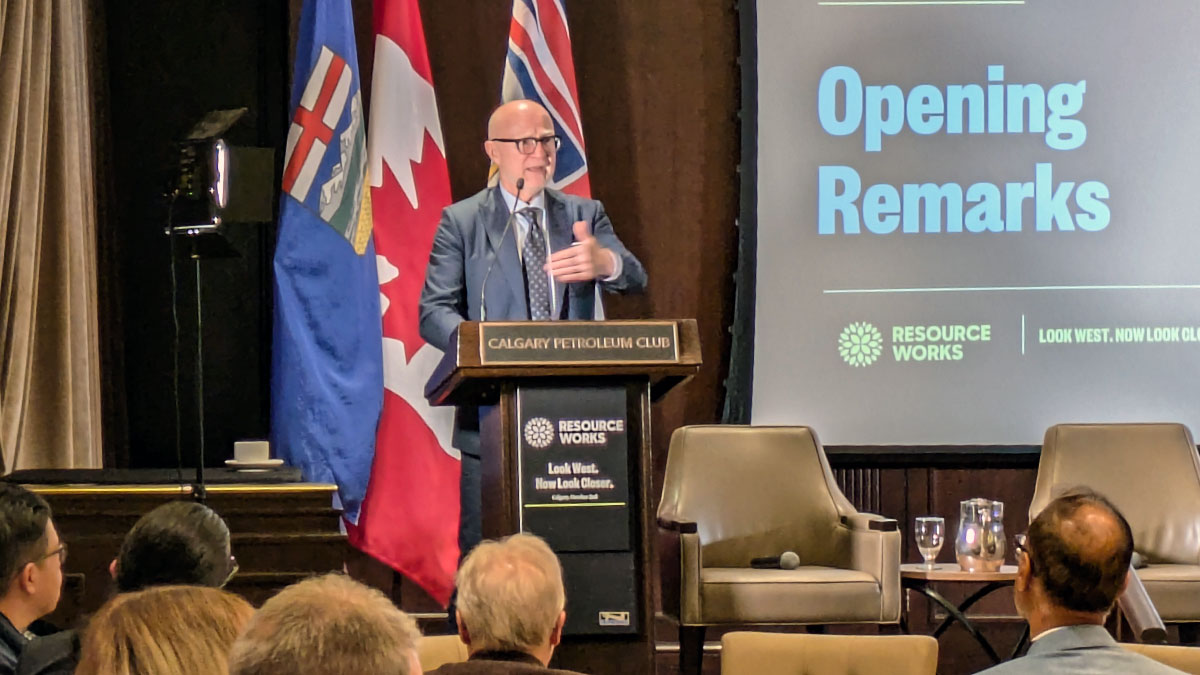
The timing couldn’t have been better for Resource Works’ event, Look West. Now Look Closer in Calgary last week. With FID on LNG Canada Phase 2 announced earlier in the week, the Pacific Link oil pipeline to B.C.’s south coast declared a project of national interest the day before, a snap B.C. election called in three weeks time and Alberta’s separation referendum later in the month, the more than 100 Indigenous, industry and political leaders gathered at the Petroleum club had much to discuss.
What came out of the room was less a debate than a diagnosis. Across seven sessions and some fifteen speakers, people who disagreed on plenty kept arriving at the same uncomfortable finding: Canada’s resources are world-class, the capital is interested, the public is more onside than it has been in years, and British Columbia still takes longer to say yes than almost anywhere its competitors operate. The day was spent on why, and on what actually moves a project when it moves.
The public moved first
Pollster Greg Lyle opened with a B.C. electorate in an unfamiliar mood. The provincial race was effectively tied, voters were irritated by the snap election call, and the old political reflexes around resource development had loosened. Support for the federal and provincial push to accelerate major projects ran better than two to one. Among people familiar with the proposed pipeline to southern B.C., support was about three to one.

The main complaint was pace. “The government is still not going fast enough,” Lyle said of the polling.
Support came with a clear condition in Lyle’s numbers. British Columbians still care about environmental performance, and regulatory review is where a proponent gets to show its work. People want projects built properly and have little patience for process that exists mainly to feed itself.
He also offered a warning that should travel well beyond the campaign. Much of the current support is tied to the trade fight with Donald Trump. Trump will eventually leave office. A durable case for development has to rest on the things Canadians keep after the immediate threat passes: access to more than one customer, reliable trade infrastructure and communities that can see where the benefits land.
Lyle’s polling on Indigenous issues was more sobering. Public esteem for Indigenous leaders remains strong, while support for special rights has softened since the Cowichan title decision and the debate over B.C.’s Declaration Act. That leaves governments and First Nations leaders with a more complicated political environment just as major-project consultation is supposed to speed up.
Local local local
The builders’ panel had little use for euphemism. Brian Fehr built a billion-dollar forest-products business from Vanderhoof and later operated across Canada and the southern United States. Sean Surerus leads a family company that helped build Coastal GasLink and Trans Mountain and is now working on the Woodfibre LNG pipeline.
Asked how B.C. compares with other places, Fehr answered plainly: Alberta and the United States are easier. His prescription for B.C. was equally plain: “Local, local, local.” Go to the community, sit down with the people who live there and learn what the project will change for them.
Surerus supplied the detail everybody remembered. His company spent 10 months trying to get permits for plumbed washrooms at an industrial job site in Squamish. In Fort St. John, the same request would have followed a routine process. A delay on a major pipeline job can cost about $2 million a day, so small administrative failures become expensive very quickly.
His request to the next provincial government was reasonable certainty. Once B.C. has approved a project, its ministries need to support the decision. Surerus called it getting everybody “on the bus.” At present, a 90-day review can lead to another 45 days, a resubmission and another round of carrying costs.
Fehr and Surerus were blunt about the obstacles, but neither treated relationships as paperwork. Surerus’s companies work with dozens of First Nations across Western Canada. Training, inclusion and the relationship left behind after a construction crew moves on all affect whether that company will be welcomed back. That is practical project management in B.C.
First Nations are setting the terms of certainty
The next panel showed why one tidy description of First Nations participation will always fail. Khelsilem, former chairperson of the Squamish Nation, Chief Aaron Pete of Chawathil First Nation, lawyer Sharon Singh and Ray Cardinal of the Indigenous Advisory and Monitoring Committee for Trans Mountain agreed on the importance of rights and relationships. They disagreed, sometimes sharply, on public opinion, the pace of consultation and where the new pipeline process is likely to end.
Khelsilem gave the day its most useful line: “First Nations are the architects of certainty.”

Section 35 jurisprudence has strengthened the negotiating position of First Nations. Industry, in his view, understood that change faster than the Crown. The Squamish Nation’s environmental assessment of Woodfibre LNG shows what this can look like when a Nation designs its own process, sets conditions and aligns its work with other regulators. The proponent still faces a real decision, but everybody knows how that decision will be made.
Singh drew the important distinction between certainty of process and certainty of outcome. Companies can help design a credible process and do the work it requires. No serious process comes with a guaranteed yes.
Cardinal was wary of squeezing consultation and fieldwork that often take several years into six to nine months. He expects the resulting mistrust to surface in regulatory challenges or litigation. Pete saw more appetite among First Nations to move quickly, pursue equity and speak publicly about the benefits. He also warned that court victories will carry less practical value if the wider public comes to see First Nations as the reason projects stall.
Any workable process will have to accommodate that range of views. Some Nations will support a project, some will oppose it and others will set conditions. Governments will get farther by dealing with those differences than by hoping they disappear.
Industry has some catching up to do
Ian Anderson’s improptu lunch address cut neatly through a decade of finger-pointing. The former Trans Mountain president welcomed the change in public and political support, then turned the challenge back on industry.
“Industry, by the way, needs to keep up,” he said.
Companies, engineering firms, consultants and lawyers have adapted to a country where projects move slowly. Faster government decisions will expose slow habits on the private-sector side too. Anderson used the example of an engineering study that once took six months and may now have to be completed in a week.
Anderson kept the environmental bar where it is. Relationships with rights holders still require time, respect and repeated visits. Canada also needs the tradespeople and technical workers to build several large projects at once. He was optimistic about the opportunity and clear about how much work it will take.

The headline is the easy part
Senator Duncan Wilson has spent much of his career inside the work that follows a major announcement. At the Vancouver Fraser Port Authority, he helped move Roberts Bank Terminal 2 through years of environmental assessment, marine questions and First Nations consultation. His view of the new federal push was supportive and usefully unsentimental.
“So much of what needs to happen is below the level of the headline,” he said.

A one-year review clock begins after the required studies are submitted. Those studies can take years. Wilson argued that legislation alone cannot fix stop-clocks, poor coordination or a department that feels no urgency. He recalled an earlier federal system where deputy ministers responsible for priority projects reported their progress to the clerk of the Privy Council each week. Nobody wanted to arrive empty-handed. A little management discipline went a long way.
Wilson also connected project approval to the reliability of the infrastructure that carries Canadian goods. Repeated disruptions at ports and railways have damaged Canada’s reputation with international customers. A new pipeline or terminal delivers limited value if buyers have to keep a backup plan for dealing with us.
His request to industry was immediate: appear before the Senate committee studying Bill C-39 and explain what delay has cost in real projects and diverted capital. Senators can work only from the official record. Showing up matters.
Decisions start close to the ground
The decision-making panel brought together three very different careers. Barry Penner served as B.C.’s environment minister and now chairs the Energy Futures Institute. Amarjeet Sohi carried the Trans Mountain file as federal natural resources minister after the Federal Court of Appeal set aside its approval. Lori Ackerman spent 11 years as mayor of Fort St. John and now serves as chief administrative officer of Prophet River First Nation.

Penner arrived with numbers. During three dry years, BC Hydro spent about $2.1 billion net on imported electricity. B.C. bought far more power than it sold and paid a higher average price for the imports. That complicates a provincial climate plan built around rapid electrification and abundant clean power.
He also presented polling showing 64 per cent support for a new oil pipeline to the south coast, including 46 per cent among Green Party voters. Governments have unusual room to act. Penner’s own permitting work also showed the other side: clients can meet every stated requirement, wait seven years for a decision and quietly take their capital elsewhere.
Sohi explained what happened after the court found the Crown’s consultation on Trans Mountain inadequate. The federal government spent 18 months rebuilding the process, visiting affected communities and responding to their concerns. The renewed approval later survived another challenge.
“It’s about trust, relationship, hard work, and meeting people where they are,” he said.
For a faster process to hold up, Sohi argued, every affected Nation needs enough capacity to participate, including Nations that oppose the project. The Crown must arrive with an open mind, make serious efforts to accommodate concerns and keep a clear record of the work.
Ackerman brought the discussion back to local capacity. Small First Nations administrations are asked to assess technically complex projects while delivering services and completing government reports. Sometimes the most useful federal or provincial contribution would be a skilled employee seconded to the Nation to do the work.
She also described what equity and own-source revenue have changed in her community. Prophet River can support education and cultural programming and is developing a program to celebrate sobriety. In Ackerman’s words, “They’re managing wealth rather than poverty.”
The investor gets the last word
Jen Gerson of The Line and strategist Mike McDonald ended the day with the loosest and funniest conversation on the program. Gerson played “amoral money,” asking why a global investor would accept B.C.’s uncertainty when Alberta offers other resources and fewer ways for a project to get stuck.
McDonald’s answer was more optimistic, with a catch. B.C. can get very large projects built when governments focus their attention and proponents have the resources to manage every relationship. LNG Canada, Site C and Coastal GasLink all made it through serious opposition and long approval processes.

The weaker spot is the middle. A $50-million or $100-million investment rarely receives the political attention of a megaproject. It can spend years moving between agencies and communities, then choose Alberta without a press release. We hear plenty about the projects governments announce. We hear much less about the ones that quietly leave.
They spent the second half on the B.C. election and Alberta’s referendum, often at each other’s expense. Both kept coming back to the question that had occupied the room all day: will this change in public mood alter the institutions that make decisions, or simply produce a fresh round of announcements?
Canada can still concentrate enough effort to build one enormous project. The better test is whether a sound $50-million project can get a timely answer without needing national attention.
The public has said yes. B.C. now has to make yes mean something.
Angela Wrigley is the Editorial and Digital Director of Resource Works and can be reached at [email protected].
Resource Works News