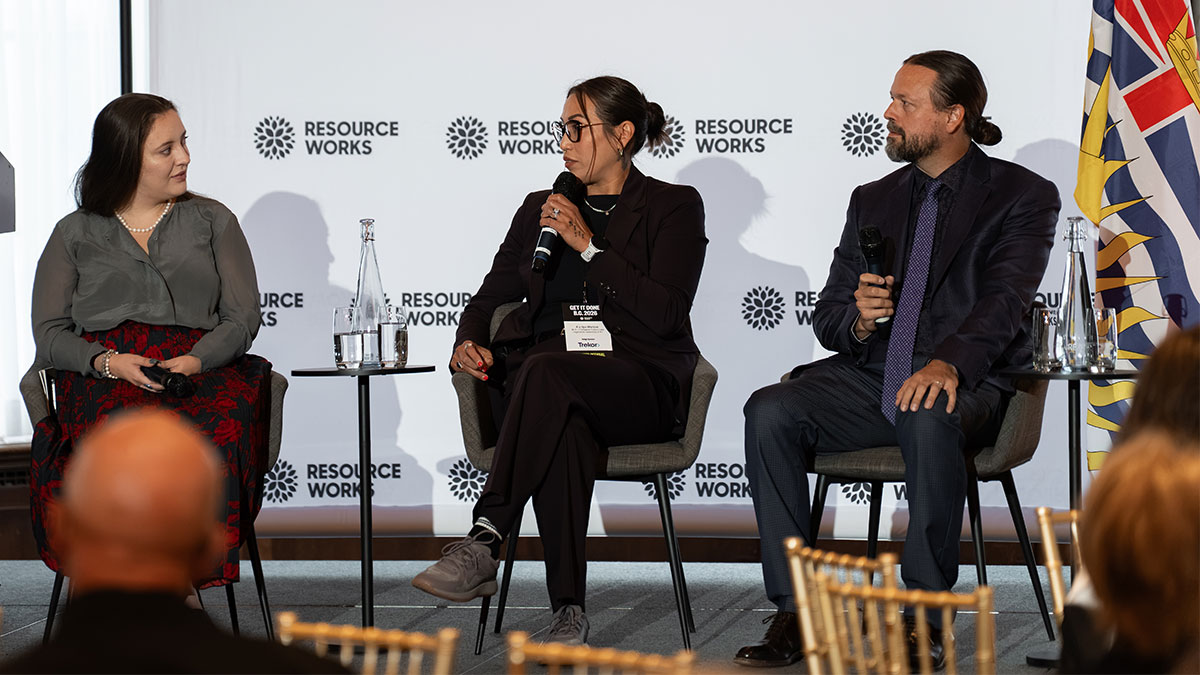
British Columbia has spent the past year immersed in an intense debate over land, title, and responsibility for the past. Tensions escalated following the landmark Cowichan decision in August 2025, and have remained high. In a panel created to shed some light on how proponents, Nations, and governments ensure project certainty, partnerships and prosperity, Get It Done BC opened with a panel tackling a central, pressing question: Why is there so much anger?
Moderated by Resource Works Managing Director Margareta Dovgal, the panel featured Á’a:líya Warbus, independent MLA for Chilliwack-Cultus Lake and member of the Stó:lō Nation, and Malcolm Macpherson, a partner at Macpherson Law with over two decades of experience negotiating agreements at the intersection of industry and Indigenous partnerships.
Real Anger, Misdirected Blame
Macpherson wasted no time in identifying the issue. Anger leads to blame, and blame looks for someone to hold responsible.
“A lot of the First Nations in B.C. are getting the finger pointed, especially post-Cowichan,” Macpherson said. “It’s just not fair. It’s a form of scapegoating.”
He said those searching for the source of B.C.’s economic challenges should focus on provincial policy and the global economy.
Warbus contextualized the underlying anxiety in everyday experiences, noting that macro-level uncertainties hit citizens directly in their daily lives—starting with the grocery aisle.
“I’m paying a lot more to feed my three kids and my family,” she said.
Scarcity makes people protective, she said. They worry about their homes, equity and savings. That concern can quickly turn into dividing people into groups and assigning blame.
“I just don’t think that the right thing to do is start pointing fingers at each other, start dividing into groups,” Warbus said.
The frustration across the province is real, both panelists agreed, but the public is directing its anger at the wrong target.
Demystifying the Cowichan Ruling
Macpherson clarified the legal reality of the court decision, noting that public anxiety largely stems from widespread misunderstandings of what the ruling entails.
The court found that the Cowichan people used the land, that they had a right, and that a transfer of land was improperly done. That’s the finding. The decision aimed at the Crown, not at homeowners.
“It specifically went out of its way to try to not unsettle private property rights.”
Despite the court’s intent, uncertainty followed. Buyers in Richmond had assumed a title search was the final word. Banks made loans on that basis. Macpherson said this is where the unease begins.
“Money runs from uncertainty.”
Rather than trying to roll back the ruling, Macpherson believes governments should create a safety net for property owners. Land claims like Cowichan are rare, and both levels of government can proactively agree on backstops to compensate anyone affected.
“There should be a backstop. That brings you market certainty.”
Governments can make this policy choice now. It doesn’t require reopening the land question or changing the Land Title Act.
He dismissed the alternative suggested in some political commentary.
“Let’s just roll the tape back,” he said. “When’s that ever worked, right?”
Treaties stall over what lies underground
B.C. remains largely unceded, and Macpherson traced the lack of progress to the terms of the deals. He has sat at treaty tables and understands why so few are completed.
“What’s being offered is very different than what used to be offered,” he said.
The challenge is not defining territory, but sharing its resources. He pointed to the Tsawwassen treaty, which he said didn’t include subsurface rights, even with hydrocarbons near Roberts Bank.
Crown negotiators work within a mandate, he said, and he respects that. He has also seen deals offered that he would not have advised a nation to accept.
“The Crowns and the nations haven’t yet come to the right recipe for royalty sharing,” Macpherson said. Until that changes, he expects the gridlock to hold.
Warbus described another complication that’s often overlooked. The reserve system was imposed, not chosen, and it left more than 200 small nations across traditional territories. Each has its own chief and council. Reaching agreement takes time.
“We still haven’t answered the land question,” she said.
She also asked people to consider the responsibilities Indigenous leaders carry into negotiations. Her brother was recently elected in their nation. He deals with issues like grief, addiction and suicide, as well as economic development.
“Indigenous leaders, they deal with way different problems than other leaders do,” Warbus said.
Macpherson sees the solution as a sharing formula that goes beyond fee simple title. Once that is in place, he expects to see more joint ventures and impact benefit agreements.
Bridging the Public Information Gap
Warbus devoted much of her message to the critical role of public education, warning that widespread information gaps allow misinformation to spread.
“Public sentiment is a really important part of democracy.”
She gave an example of what is often misunderstood. One nation’s title area is about the size of a country, she said, but its exclusive jurisdiction covers only about two per cent. The rest is managed through consultation and partnership. Success stories are also overlooked. Treaty nations have built real prosperity, she said, but few people can explain how.
“It’s not easily accessible information, and it needs to be accessible to British Columbians. We have to answer their questions before we can bring them along.”
She was clear about the consequences when this does not happen.
“What politicians do is they stoke the flames, and they go, well, how can I get more votes out of this? That’s wrong.”
Her case for urgency is personal. Nations are staying, but other British Columbians are leaving.
“This is our homeland. This is our territory.” Meanwhile, she works with people whose children and grandchildren are moving away.
Macpherson concluded by reiterating that Section 35 constitutional rights are permanent fixtures of Canadian law. Far from being obstacles, collaborative partnerships with First Nations offer the fastest path to securing clean energy, mining, and sustainable infrastructure investments.
“There needs to be a collective wake up, and to see the nations as allies.”
Warbus spelled out the process. After two years of hearing the same story at conferences, she noticed a pattern. The projects that led to real development and shared prosperity didn’t begin with a legal opinion. They began when two parties sat down together.
“They started with tea.”
The conversations continued. Her message to the room was to take those stories with them and put the lessons into practice.
Ian Biana writes for the Resource Works Accelerate team and can be reached at [email protected].
Resource Works News