The cat was already out of the bag by the time federal Energy and Natural Resources Minister Tim Hodgson showed up in Vancouver Thursday to announce a second Indigenous partnership group taking an equity stake in Coastal GasLink.
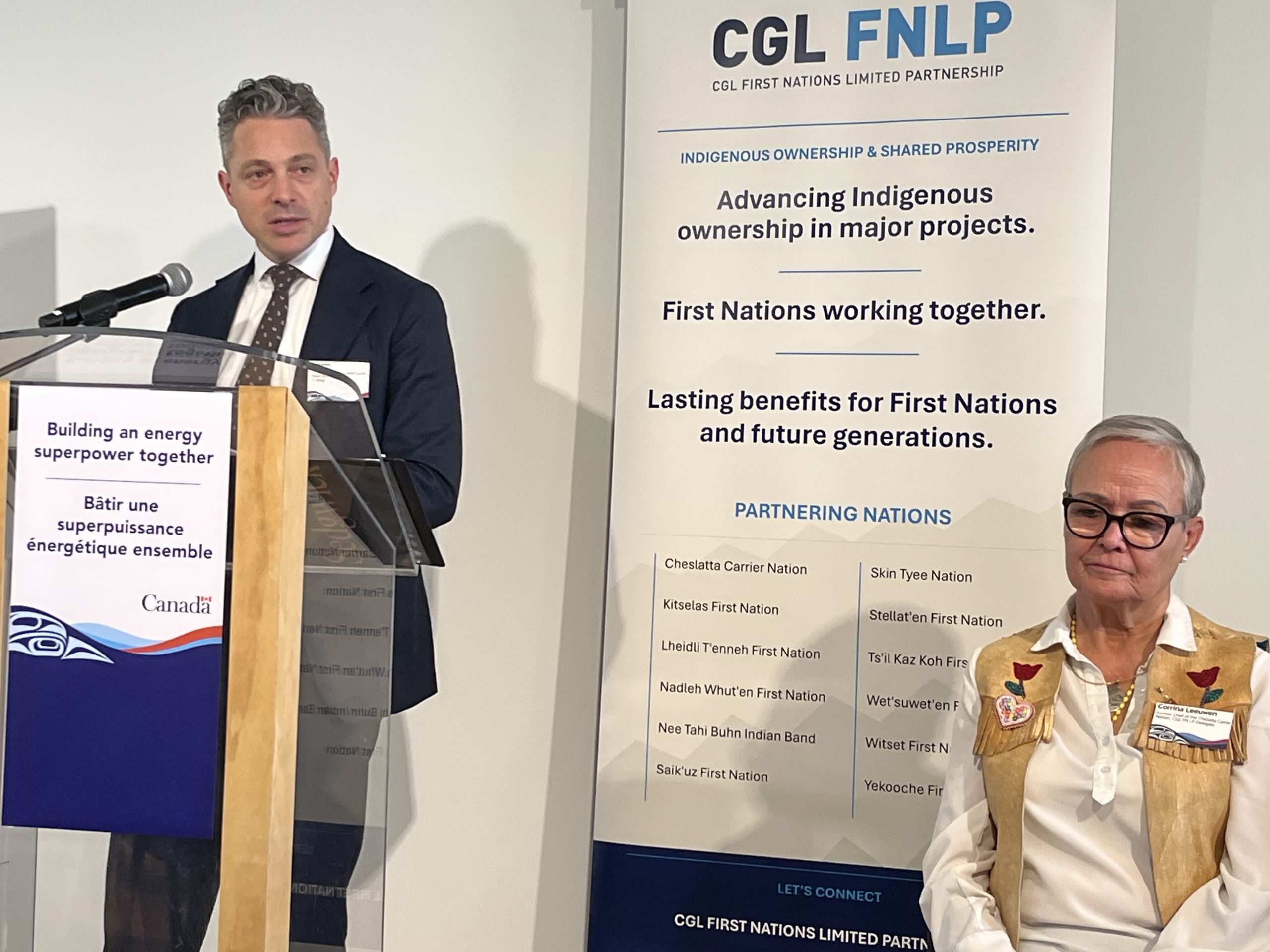
At a press conference Thursday, Hodgson, TC Energy and members of the CGL First Nations Limited Partnership confirmed what the Globe and Mail had reported Nov. 24 – that 12 First Nations from northern B.C. will take an equity stake in the Coastal GasLink pipeline, which feeds the LNG Canada plant in Kitimat and which will also supply the Haisla’s Cedar LNG.
The equity stake is being backed with a $168 million loan guarantee from the Canada Indigenous Loan Guarantee Corporation.
The buy-in is taking place just as TC Energy is planning an expansion to CGL to meet the demands of the LNG Canada Phase 2 expansion.
TC Energy owns 35 per cent of CGL, with 65 per cent jointly owned by Alberta Investment Management Corp. (AIMCo) and New York-headquartered investment firm KKR.
The equity agreement announced Thursday will see the 12 First Nations in the CGL FNLP taking a position in TC Energy’s 35 per cent ownership position.
The Globe and Mail reported that CGL FNLP will be buying an 11 per cent stake in TC Energy’s share of CGL, which would mean they would own 3.85 per cent of the total CGL pipeline.
When asked to confirm those numbers, officials at Thursday’s press conference declined. The actual equity position CGL FNLP will take is confidential, said Jesse Bajnok, TC Energy’s project vice president of CGL.
“Collectively we own 35 per cent of the project,” he said. “Otherwise, any further details of the agreement are confidential.”
This is the second First Nations equity investment in CGL announced recently.
Last month, it was announced that five nations under the FN CGL Pipeline Limited Partnership will also take an equity stake, though it wasn’t disclosed how big of a stake it will be.
Those nations include the McLeod Lake Indian Band, Haisla, Halfway River, Saulteau and West Moberly First Nations.
It is unclear just how much of CGL the two First Nations groups will own.
CGL was built by TC Energy at a cost of about $14 billion. The pipeline is now about to undergo a $4.9 billion expansion that will double its capacity from 2.1 bcf/d to 4.5 bcf/d.
Much of that expansion will come in the form of additional compressor stations. The work is expected to start in the new year.
CGL’s owners generate revenue through service agreements with the buyers of the gas – that is, the six partners in the LNG Canada project.
Corrina Leween, a director for CGL FNLP, said the agreement is a major milestone for First Nations.
She noted that the members of the partnership signed an equity option agreement with TC Energy four years ago, when CGL was still being built.
“For many of our communities, this was something new,” she said. “We were no longer simply discussing the impacts of a project, or the opportunities available during discussion. We were discussing how our nations could participate in the long-term economic development and benefits of that infrastructure.
“We were discussing ownership.”
As it was pointed out Thursday, one of the biggest barriers to First Nations becoming real partners in major projects has been a lack of financing.
The $5 billion Canada Indigenous Loan Guarantee program has removed some of those barriers, allowing First Nations access to low interest loans and loan guarantees in order to buy into major infrastructure and resource projects.
Hodgson noted his government has since doubled the loan guarantee program from $5 billion to $10 billion. Such partnerships are particularly important for the energy sector, he said.
“Today’s announcement is a powerful example of what can be achieved when First Nations, when industry and governments work together to advance projects that will bring prosperity, security and sovereignty to our country and, importantly, to First Nations,” Hodgson said.
Revenue from CGL will provide the 12 nations with own-source revenue, to be spent as they see fit.
“The economic benefit generated through the investment will support the things that matter most to our respective nations,” Leween said.
“For some communities that may mean investing in housing and essential infrastructure. For others it may mean supporting education, strengthening cultural programs, supporting our elders and youth, or investing in services that improve the health and well-being of our people.”
Partners in the CGL FNLP are: Cheslatta Carrier, Kitselas, Lheidli T’enneh, Nadleh Whut’en, Nee Tahi Buhn, Saik’uz, Skin Tyee, Stellat’en, Ts’il Kaz Koh, Wet’suwet’en, Witset and Yekooche First Nations.
Nelson Bennett’s column appears weekly at Resource Works News. Contact him at [email protected].
Resource Works News